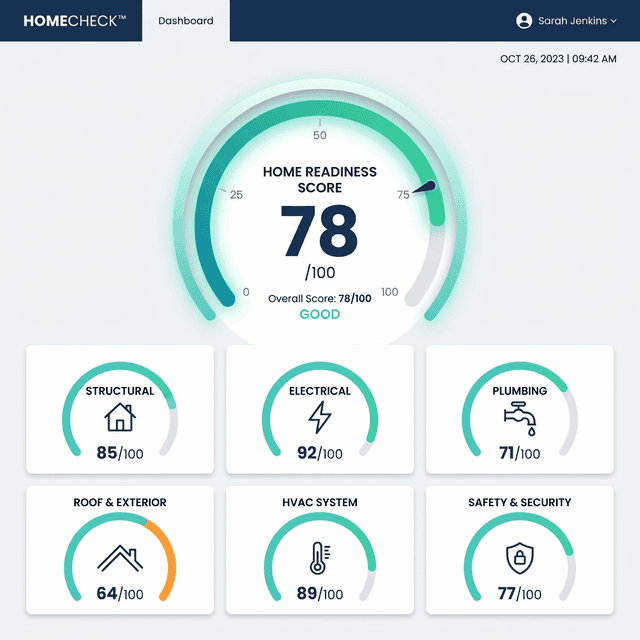
TL;DR: Synthesizing public data from the U.S. Census, American Housing Survey, Hippo, the Insurance Information Institute, AAA, Pearl Certification, and Angi, the typical American home scores roughly 62/100 on the 6-dimension Home Readiness Score framework — a "Good, with gaps" rating. The weakest dimensions for most households are Insurance Readiness (54), Documentation (57), and Warranty Coverage (59). Maintenance and Safety score higher on average, but 92% of homeowners still carry outstanding deferred repairs. This is a benchmark model built from industry data, not a study of ConductorIQ customer data. Use it to see roughly where you stand — and which dimension will move your score fastest.
Table of Contents
- What Are Home Readiness Benchmarks?
- Our Benchmark Methodology: How We Modeled the Typical Home
- The Typical American Home: 62/100 (Explained)
- Benchmarks by Home Age
- Benchmarks by Geography
- Benchmarks by Household Size and Type
- Benchmarks by Dimension: Where Most Homes Fall Short
- The Gap Between Score and Self-Perception
- How to Know Where You Stand and Improve Fastest
- FAQ: Home Readiness Benchmarks
What Are Home Readiness Benchmarks?
Home readiness benchmarks are reference values that show how a typical home performs across the six dimensions of the Home Readiness Score: Maintenance, Asset Documentation, Warranty Coverage, Safety and Emergency Readiness, Insurance Readiness, and Document Organization. They turn "is my home doing OK?" into a comparable number — roughly 62/100 for the average U.S. home, based on synthesized public data.
The Home Readiness Score itself is ConductorIQ's framework, originally introduced in the pillar explainer and broken into its scoring formula in How to Calculate Your Home Readiness Score. A benchmark is different from the score itself. The score is a measurement of your home. A benchmark is the reference point you compare against — the "average" that lets a 74 feel meaningful and a 48 feel urgent.
Credit scores work the same way. FICO publishes average scores by age, region, and income. That context is what makes your own number actionable. Home ownership has never had that layer — until now.
The six dimensions at a glance:
- Maintenance Compliance — are scheduled tasks being done on time?
- Asset Documentation — is the home's inventory (HVAC, appliances, roof, etc.) cataloged?
- Warranty Coverage — are active warranties tracked and used?
- Safety and Emergency Readiness — detectors, shutoffs, emergency plan?
- Insurance Readiness — adequate coverage, current documents, claim-ready inventory?
- Document Organization — deed, policies, permits, manuals digitized and findable?
This post focuses on what "typical" looks like on each of those, and why your score probably differs from what you'd guess.
Our Benchmark Methodology: How We Modeled the Typical Home
These benchmarks are a synthesis of public industry data, not an analysis of ConductorIQ customer data. We mapped published statistics from the U.S. Census Bureau, the American Housing Survey, Hippo's Homeowner Preparedness Report, the Insurance Information Institute, AAA, Consumer Reports, Pearl Certification, Angi, and HomeGuide onto the six scoring dimensions to estimate how a typical U.S. single-family home would score.
Here is how each dimension was modeled, so you can see our assumptions:
- Maintenance Compliance (65/100). Anchored on Hippo's finding that 92% of homeowners have outstanding home repairs and that roughly 60% of households defer maintenance for cost reasons. "Some overdue tasks, no critical system at risk" lands in the mid-60s.
- Asset Documentation (63/100). Modeled from industry inventory studies: most households can recall their largest appliances but cannot produce model numbers, install dates, or serial numbers for the majority of their 15–20 major systems.
- Warranty Coverage (59/100). With the average U.S. home aged about 43 years (Census 2023 AHS), most original system warranties have expired. The benchmark reflects partial appliance-warranty awareness and very little tracking of HVAC, roof, or extended coverage.
- Safety and Emergency Readiness (68/100). Building codes drive smoke and CO detector adoption. But preparedness research shows only ~5% of homes have a fully stocked emergency kit, and large minorities don't know their disaster coverage. "Basic safety yes, emergency planning no" lands in the high 60s.
- Insurance Readiness (54/100). The weakest dimension. The Insurance Information Institute and claims data suggest roughly 30% of home insurance claims are underpaid or delayed due to missing or inadequate inventory, and a large share of U.S. homes are underinsured against replacement cost.
- Document Organization (57/100). Modeled from filing-habit surveys and self-reports about locating deeds, policies, and receipts "within a few minutes." Most homeowners have critical documents somewhere — just not indexed, searchable, or centralized.
Weighting follows the scoring model in How to Calculate Your Home Readiness Score: Maintenance 25%, Asset Documentation 20%, Financial/Insurance 20%, Warranty 15%, Emergency Preparedness 10%, Document Organization 10%. Applied to the dimension benchmarks above, the weighted composite for the "typical U.S. home" comes out to ~62/100.
Important honesty note. This is a modeled benchmark, not a measurement. It is designed to give you directionally useful context — not to replace a real measurement of your own home. ConductorIQ has not yet published a customer-data benchmarking study, and this post does not reference user averages or customer cohorts.
Want your actual number instead of the model average? ConductorIQ calculates your Home Readiness Score automatically as you document your home. Check your score free →
The Typical American Home: 62/100 (Explained)
The typical U.S. single-family home scores about 62/100 on the Home Readiness framework — firmly inside the "Good, with gaps" tier from the pillar scoring guide. The number is not low because homeowners are careless. It's low because most homes are strong in 2–3 dimensions and weak in 2–3 others, and a composite score punishes imbalance.
Here is the dimension-by-dimension breakdown we used to arrive at 62:
Table 1: Typical Home Readiness Score Breakdown by Dimension
| Dimension | Weight | Typical Score | Typical Percentile | What's Driving It |
|---|---|---|---|---|
| Maintenance Compliance | 25% | 65 | ~50th | 92% of homeowners carry outstanding repairs (Hippo) |
| Asset Documentation | 20% | 63 | ~45th | Major appliances known, details missing |
| Insurance Readiness | 20% | 54 | ~40th | Coverage exists, inventory does not |
| Warranty Coverage | 15% | 59 | ~45th | Appliance warranties partial, system warranties untracked |
| Safety & Emergency Readiness | 10% | 68 | ~55th | Code-required detectors strong, prep weak |
| Document Organization | 10% | 57 | ~45th | Docs exist but aren't indexed |
| Weighted Composite | 100% | ~62 | 50th | "Good, with gaps" |
A few patterns jump out of this table that matter for how you interpret your own score:
The weighted dimensions drag the composite down. Maintenance, Asset Documentation, and Insurance Readiness together account for 65% of the score. These are exactly the dimensions where most homes underperform. A home that's great at safety and documents but mediocre at maintenance and insurance will land near 62 — even though it "feels" well-managed.
"Average" is not safe. A 62 means the typical home is roughly one bad surprise away from an expensive problem: an unfiled insurance claim paid out at 60% of true loss because the inventory was missing, a warranty-covered repair paid out of pocket because nobody knew it was covered, or a deferred maintenance task that compounded at the 4-to-7x rule into a real bill.
The distribution is wider than the average. The model suggests the 25th percentile home scores near 48 (multiple critical gaps) and the 75th percentile home scores near 76 (solid fundamentals, small gaps). Scores cluster, they don't huddle.
Benchmarks by Home Age
Home age is the single biggest predictor of which dimensions score high and which score low. Newer homes score higher on warranty coverage and maintenance, older homes score higher on documentation (because owners have accumulated records over time), and mid-life homes — 30 to 50 years old — tend to be the weakest overall because major systems have aged past warranty but haven't yet been replaced.
The U.S. Census and American Housing Survey put the median age of an owner-occupied home at about 43 years, which means the "typical" home is squarely in the mid-life bracket where readiness tends to dip.
Table 2: Home Readiness Benchmark by Home Age
| Home Age Bracket | Typical Overall Score | Strongest Dimension | Weakest Dimension | Key Pattern |
|---|---|---|---|---|
| New (<10 years) | ~68 | Warranty Coverage (78) | Document Organization (52) | Still under original warranty, but owners haven't built a filing system |
| Established (10–30 years) | ~64 | Maintenance Compliance (68) | Insurance Readiness (52) | Systems aging into first replacements; insurance lags behind asset values |
| Mid-Life (30–50 years) | ~58 | Safety & Emergency (66) | Warranty Coverage (48) | Past original warranties; replacements not yet consistent |
| Older (50+ years) | ~60 | Asset Documentation (68) | Maintenance Compliance (55) | Long history of receipts but backlog of deferred tasks |
New homes (under 10 years) benefit from active builder and manufacturer warranties and from fewer maintenance cycles. They underperform on documentation because new homeowners often haven't indexed closing documents, permits, and appliance manuals. A new home with a low-70s score can drift into the mid-50s within five years if documentation doesn't get built.
Established homes (10–30 years) hit the first major-system replacement — water heater at ~10 years, HVAC between 12 and 18, roof between 18 and 25 depending on material. Maintenance habits are usually solid, but underinsurance risk grows because asset values and replacement costs have risen faster than policy updates.
Mid-life homes (30–50 years) are the lowest-scoring overall. The median U.S. home sits in this bracket. Original warranties are long expired, multiple systems have aged past expected lifespan, and deferred maintenance compounds. Owners often feel fine because the home "still works," but per our 4-to-7x rule post, financial exposure here is highest.
Older homes (50+ years) score slightly higher than mid-life homes in the model. Owners have typically replaced major systems at least once and accumulated a long paper trail. The weakness is maintenance backlog — older homes have more items to keep up with than the calendar allows. For a full age-by-age playbook, see Home Maintenance Schedule by Age.
Benchmarks by Geography
Regional climate and regulatory context shape which dimensions matter most — and where typical homes are strongest or weakest. Homes in the Northeast score higher on insurance and documentation (older housing stock, stricter codes, more complex coverage needs drove habit). Homes in the West score higher on safety (wildfire and earthquake preparedness are more visible). Homes in the South and Midwest score closer to the national average, with different weak spots in each.
The American Housing Survey and industry claims data inform these patterns. None of these regional differences are huge — the spread across regions is roughly 6 points on the composite — but the underlying dimension patterns differ meaningfully.
Table 3: Regional Benchmarks
| Region | Typical Overall Score | Strongest Dimension | Region-Specific Risk |
|---|---|---|---|
| Northeast | ~64 | Document Organization (62) | Aging housing stock, ice-dam and boiler maintenance backlog |
| South | ~61 | Maintenance Compliance (66) | Hurricane/flood coverage gaps, humidity-driven deferred maintenance |
| Midwest | ~62 | Safety & Emergency (70) | Basement flooding, tornado prep, outdated HVAC |
| West | ~63 | Safety & Emergency (72) | Wildfire insurance gaps, earthquake coverage rarely held |
Northeast. Oldest housing stock in the country — often pre-1960 — so owners have inherited decades of documents and learned to work with complex policies. Weak spots: boiler, chimney, and ice-dam-related maintenance backlog, and older appliances that are harder to document.
South. Newest housing stock, which improves warranty numbers. But hurricane and flood coverage are often misunderstood — industry research shows a large share of Southern homeowners incorrectly assume standard policies cover flood damage. Humidity-driven deferred maintenance drags the maintenance dimension below its code-driven baseline.
Midwest. Strong on safety (tornado-prep culture) and on maintenance (hard winters force regular service). Weakest on insurance readiness because replacement-cost coverage often lags when home values rise quickly. Basement flooding claims are a major source of underpaid claims — almost always tied to missing inventory.
West. High safety scores driven by earthquake and wildfire awareness. Insurance is the swing dimension: earthquake coverage is rarely held, and wildfire insurance has become harder to obtain, widening the gap between "have insurance" and "insurance that would actually cover loss."
Benchmarks by Household Size and Type
Household size and composition shift readiness more through behavior than assets. Larger households generate more entropy — more documents, more appliances, more maintenance tasks — which tends to pull scores down on documentation and warranty tracking. Smaller and single-adult households often score higher on document organization but lower on maintenance because a single person is absorbing all the work.
A few patterns from the modeled benchmark:
- Single-adult households (~60). Strong documentation, but maintenance compliance drops with no second adult to backstop scheduling. Emergency preparedness is the most common weak spot.
- Couples, no kids (~66). Highest-scoring group. Split responsibilities produce more consistent maintenance and documentation. Warranty tracking is the common weakness — neither partner is sure who kept the receipt.
- Families with children (~61). Near the national average, with dips on document organization and warranty coverage. More stuff, more activity, less time erodes the administrative dimensions.
- Multigenerational households (~63). Slightly above average. More hands for maintenance, older members carrying long-term records. Emergency plans often overlook one generation's needs.
- Landlords and small portfolio owners (~55 per property). Below owner-occupants on any single property, but this is where a consistent tracking platform pays the largest compounding benefit — per-property overhead drops to near zero after the first.
Income brackets correlate weakly with score. Higher-income households have more assets to document (headwind) but more budget for preventive maintenance (tailwind). The two effects roughly cancel.
Benchmarks by Dimension: Where Most Homes Fall Short
Across every age bracket, region, and household type, the same three dimensions consistently underperform: Insurance Readiness, Document Organization, and Warranty Coverage. These are the "administrative" dimensions — they don't require money or physical labor, just attention and a system — which is why they're easiest to ignore and easiest to improve.
Here's the pattern behind each weakness.
Insurance Readiness (~54, the weakest). The typical home has homeowners insurance. What it doesn't have is a claim-ready home inventory. The Insurance Information Institute notes that disputes and delayed claims are most often tied to incomplete documentation at the moment of loss. Industry estimates put the share of claims underpaid or delayed due to missing inventory at roughly 30%, with an average per-household shortfall measured in thousands of dollars. Having insurance is not the same as being insured. That gap is what this dimension measures. For context, see Home Asset Inventory: Why Every Homeowner Needs One.
Document Organization (~57). Most homeowners have their critical documents. They don't have them findable. Deeds are in a closing folder in a box in the basement. Insurance declarations pages are a PDF from the 2022 renewal, buried under 3,000 unrelated emails. Appliance manuals are in a kitchen drawer. The document dimension is a search-time problem, not an ownership problem, and it's the fastest dimension to improve with OCR-based digitization.
Warranty Coverage (~59). The average home is ~43 years old, which means most original structural warranties have expired. But most homes also have 3–6 appliances under active warranty at any given time — and the typical household tracks maybe one or two. Consumer Reports' ongoing appliance reliability work shows that warranty claims are a significant unused source of value, largely because owners don't know the clock is still running. See How to Track Home Warranties for the mechanics.
The stronger dimensions — Maintenance (65), Safety (68), Asset Documentation (63) — are stronger because they have forcing functions. Code inspections nudge safety. Visible problems nudge maintenance. The administrative dimensions have no forcing function at all, which is why they drift downward without a system.
The takeaway for individual homeowners: if your goal is to raise your Home Readiness Score with the least effort, start with the administrative dimensions. They're the lowest-hanging fruit at any starting score.
The Gap Between Score and Self-Perception
The most interesting pattern in the benchmark isn't any single dimension — it's the gap between where people think their home stands and where it actually does. Survey data consistently shows that homeowners rate themselves as "above average" on home maintenance and preparedness, while the measurable dimensions tell a different story.
Signals from the data bank:
- 92% of homeowners have outstanding home repairs (Hippo) — yet most describe themselves as "caught up."
- 54% of homeowners report feeling burned out on maintenance (industry surveys) — incompatible with "mostly caught up."
- ~46% of first-time homeowners say they didn't understand maintenance costs before buying, and ~42% report maintenance regret (Bankrate).
The gap isn't about denial. It's about measurement. A furnace that turns on when you want heat feels well-maintained, even if it hasn't been serviced in four years and its warranty lapsed in 2022. The Home Readiness Score makes the invisible visible. If the typical homeowner feels like they're at 80 but the data suggests 62, then measuring yourself honestly is almost always a surprise — and that surprise is the starting point for improvement.
How to Know Where You Stand and Improve Fastest
The fastest way to know where you actually stand is to measure — and the fastest way to raise your score is to focus on the three dimensions where the typical home is weakest. Across every age bracket and region modeled, the highest-leverage actions are: build a claim-ready inventory, digitize your critical documents, and tag your active warranties. Together, those three moves can shift a typical home from the low-60s into the mid-70s within 4–6 weeks.
The shortest path from average to strong:
- Week 1 — Inventory the top 15 assets. HVAC, water heater, roof, electrical panel, major appliances, washer/dryer, garage door opener. Capture make, model, serial number, install date, and a nameplate photo. Moves Asset Documentation from the mid-60s into the 80s and lifts Insurance Readiness because your claim inventory now exists. Walkthrough: Home Asset Inventory.
- Week 2 — Digitize the core document pack. Deed, title insurance, current insurance declarations page, mortgage statement, property survey, HOA documents. Scan and index by category. Moves Document Organization from the mid-50s into the 80s in a single afternoon.
- Week 3 — Map active warranties to the inventory. Search email for purchase confirmations and registrations on your Week 1 assets. Record start, duration, expiration. Flag any still-active warranty. Mechanics: How to Track Home Warranties.
- Week 4 — Close out one overdue maintenance task per major system. You don't need to catch up on everything — just one per system to reset your compliance signal. The 4-to-7x rule post shows why this matters financially.
- Ongoing — Review insurance annually. Match policy limits to documented asset values. Confirm region-specific coverage (flood, earthquake, wildfire) is actually in force.
A typical home that completes these four weeks moves from ~62 to ~76. The math works because the weakest dimensions have the most headroom.
FAQ: Home Readiness Benchmarks
Where does my home stand compared to average?
The typical U.S. home scores around 62/100 in our synthesized benchmark. If you're above 70, you're already doing better than most homeowners on the dimensions that matter financially. If you're below 55, you likely have gaps in the administrative dimensions — insurance inventory, documents, warranties — rather than physical maintenance. Those are the cheapest to close.
Do new homes automatically score higher?
Not by as much as you'd think. Our benchmark puts new homes (under 10 years) at about 68/100 — only 6 points above the national average. New homes benefit from active warranties and newer systems, but they often underperform on document organization because owners haven't built a filing system yet. A new home with low documentation can easily slip below a well-managed 30-year-old home.
Why is insurance readiness the weakest dimension for most homes?
Most households have insurance but lack the claim-ready inventory that turns coverage into actual recovery. The Insurance Information Institute reports that a large share of home claims are underpaid or delayed due to missing documentation. The gap is not about premiums — it's about whether you can prove what you owned when you file. That's why this dimension benchmarks near 54/100, the lowest of the six.
Can I improve my score significantly in 3 months?
Yes. A typical home at 62 can reach the mid-70s in 4–6 weeks by focusing on the administrative dimensions: build an asset inventory (Week 1), digitize core documents (Week 2), map active warranties (Week 3), and close out one overdue task per major system (Week 4). None of these require major spending. They require a system and a few focused hours.
Is this benchmark based on ConductorIQ user data?
No. This is a benchmark model synthesized from public industry data — U.S. Census, the American Housing Survey, Hippo, the Insurance Information Institute, AAA, Consumer Reports, Pearl Certification, and Angi — mapped onto the six Home Readiness Score dimensions. It is not an analysis of ConductorIQ customer data. When ConductorIQ publishes its first customer benchmark study, it will be clearly labeled as such and will reference real user averages.
Which dimension should I improve first?
Start with whichever dimension is lowest for you, but on average the fastest wins are in Asset Documentation and Document Organization — they require data entry, not physical labor or budget. For most homes modeled here, those two dimensions alone account for 10–15 points of composite upside within a week.
How does this compare to a home inspection?
A home inspection is a one-time snapshot of physical condition. A Home Readiness Score is a continuous measurement across six dimensions including documentation, warranties, and insurance that an inspector does not evaluate. Both are useful. The benchmark in this post tells you how a typical home scores on the continuous measurement — not whether a home would pass inspection.
Find Out Where Your Home Actually Stands
The 62/100 number is a useful anchor, but it's not your number. Your home is older or newer than average, in a different climate, with a different set of systems, and a different documentation history. The only way to know where you actually stand is to measure — and the only way to improve is to know which dimension is pulling you down.
ConductorIQ calculates your Home Readiness Score automatically as you document your property. You get a dimension-by-dimension breakdown, a percentile against the benchmark, and a prioritized list of the next actions that would move your score the most. It's free to check, and most homeowners move from "I think I'm doing fine" to "here are the three things I should do this month" in about 20 minutes.
Check your Home Readiness Score free at conductoriq.com →
Methodology note: All benchmark values in this post are modeled from public industry data sources cited inline — U.S. Census Bureau, American Housing Survey, Hippo Homeowner Preparedness Report, Insurance Information Institute, Consumer Reports, AAA, Pearl Certification, Angi, and HomeGuide. No ConductorIQ customer data is referenced. Benchmarks are rounded to whole numbers and should be read as directional — not precise — estimates. Last updated May 2026.