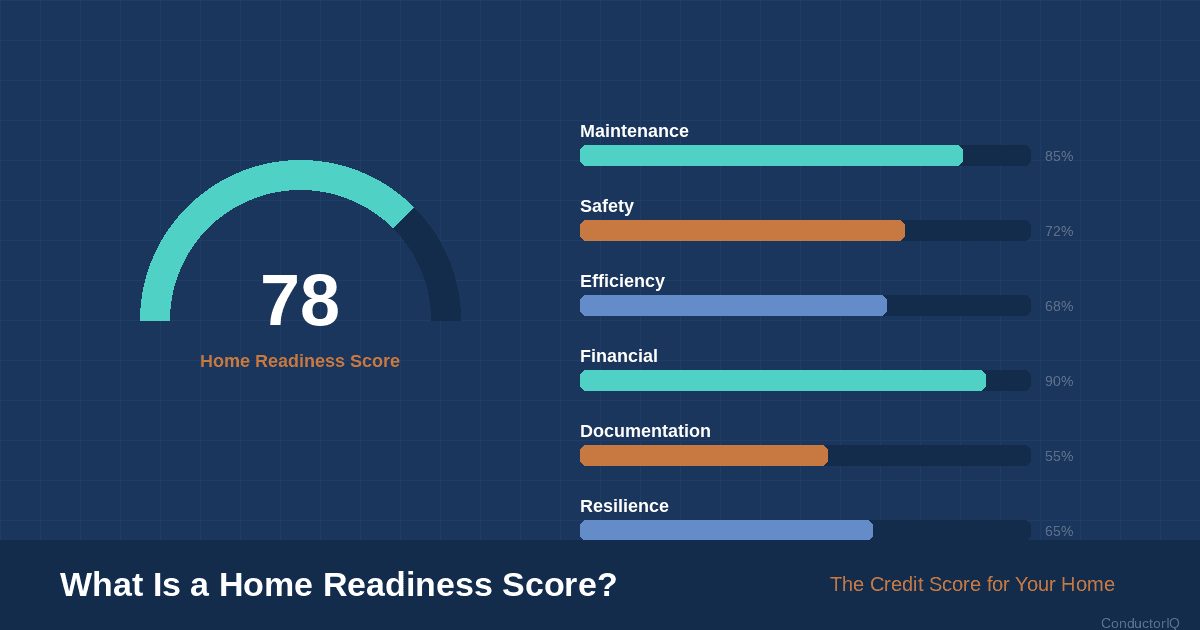
TL;DR: A Home Readiness Score is a 0-100 metric that measures how well your home is tracked, maintained, and protected across six dimensions. Think of it as a credit score for your property. It turns the invisible complexity of homeownership into a single, actionable number so you always know where your home stands and what to do next.
Table of Contents
- What Is a Home Readiness Score?
- Why Your Home Needs a Readiness Score
- The Scoring Scale: What the Numbers Mean
- Dimension 1: Asset Coverage
- Dimension 2: Warranty Coverage
- Dimension 3: Maintenance Score
- Dimension 4: Document Score
- Dimension 5: Emergency Preparedness
- Dimension 6: Overall Score
- How to Improve Your Home Readiness Score
- Who Benefits from a Home Readiness Score
- How ConductorIQ Calculates Your Score
- Frequently Asked Questions
What Is a Home Readiness Score?
A Home Readiness Score is a composite metric, scaled from 0 to 100, that measures how well your home is tracked, maintained, documented, and prepared for the unexpected. It evaluates six distinct dimensions of homeownership and distills them into a single number that tells you, at a glance, whether your home is thriving or silently falling behind. ConductorIQ created this concept because homeowners deserve the same clarity about their property that a credit score provides about their finances.
Most homeowners operate with a blind spot. They know their credit score, their car's mileage, even their daily step count. But ask them how many of their home's major systems are under active warranty, whether their maintenance schedule is current, or if they could produce their deed and insurance policy within five minutes, and confidence evaporates.
That blind spot has real consequences. According to Bankrate's 2025 Hidden Costs of Homeownership Study, the average homeowner spends $21,400 annually on costs associated with owning and maintaining a home. Forty-two percent of homeowners say those costs were higher than they expected. And research on deferred maintenance shows that homes with obvious maintenance issues sell for 10-20% below market value.
The Home Readiness Score exists to close that gap. It takes the abstract, overwhelming, and often-ignored work of managing a home and converts it into something concrete: a number you can track, improve, and act on.
If your credit score reflects how responsible you are with money, your Home Readiness Score reflects how responsible you are with your largest asset.
Why Your Home Needs a Readiness Score
Your home is likely the most expensive thing you will ever own, yet it is probably the least measured asset in your life. A Home Readiness Score changes that by giving you a framework to quantify the health of your property, identify weaknesses before they become emergencies, and build a documented history that protects your investment over time.
Here is the financial reality most homeowners face but rarely confront head-on:
Maintenance costs are rising. The average homeowner now spends approximately $8,808 per year on maintenance alone — more than double what the old "1% rule" would suggest for a median-priced home. National spending on home renovation and repair is projected to reach $526 billion by the first quarter of 2026, according to the Joint Center for Housing Studies. These are not optional expenses. They are the cost of protecting your investment.
Deferred maintenance compounds like debt. A $500 repair ignored this year becomes $535 next year at a 7% compound rate. A minor roof leak left unaddressed for three years can escalate from a $1,000 fix to a $15,000 problem requiring full replacement and interior water damage remediation. Properties needing major system replacements face buyer discounts of 15-25% off market value.
Most homeowners are not prepared for emergencies. Only 54% of U.S. households have made any emergency preparations in the past year. Just 5% of homes have a fully stocked emergency supply kit, and 41% of homeowners incorrectly believe their standard home insurance covers flood damage.
Documentation gaps cost real money. Home inspectors compare evaluating a property without maintenance records to a doctor examining a patient with no medical history. Buyers feel more confident — and pay more — when a seller can produce documented proof of consistent maintenance, timely repairs, and organized records. Yet most homeowners could not produce a complete maintenance history for their property if asked.
A Home Readiness Score brings all of these factors together. Instead of hoping things are fine, you know exactly where your home stands. Instead of reacting to emergencies, you prevent them. Instead of guessing what a buyer will think of your maintenance history, you can show them a number backed by data.
The Scoring Scale: What the Numbers Mean
The Home Readiness Score uses a simple 0-100 scale divided into four tiers. Each tier gives you an immediate, intuitive understanding of where your home stands and how urgently you need to take action. Below is the breakdown of each scoring tier, what it typically indicates, and how you should respond.
80-100: Excellent
Your home is well-tracked, consistently maintained, and prepared for the unexpected. Major systems and appliances are documented in your asset inventory. Warranties are active and monitored. Maintenance tasks are completed on schedule. Essential documents are stored and accessible. Emergency contacts, safety systems, and insurance information are current.
What it means in practice: You could sell your home tomorrow and hand a buyer a complete property history. You could file an insurance claim and produce every receipt and policy document within minutes. You could hand your property to a manager and they would have everything they need.
60-79: Good
You have solid fundamentals in place, but there are notable gaps in one or more dimensions. Perhaps your maintenance schedule is current but you have several expired warranties you haven't replaced. Maybe your documents are well-organized but you haven't logged all your major appliances. You are doing better than most homeowners, but there is room to strengthen your position.
What it means in practice: You are unlikely to face major surprises, but you are leaving some protection on the table. A focused effort on your weakest dimension could move your score significantly.
40-59: Needs Work
There are meaningful gaps in your home's coverage. You may be tracking some systems but missing others entirely. Maintenance tasks may be overdue. Key documents may be scattered or missing. Warranty coverage may have lapsed on critical equipment. This is the range where deferred maintenance starts compounding and where a single unexpected failure could result in significant out-of-pocket cost.
What it means in practice: You should prioritize your lowest-scoring dimension and address it within the next 30 days. The longer gaps persist at this level, the more expensive they become to close.
0-39: Critical
Your home has significant blind spots across multiple dimensions. Major systems may be untracked, warranties expired, maintenance overdue, and essential documents missing or inaccessible. At this level, you are exposed to unnecessary financial risk and likely unaware of issues that are already developing behind walls, under roofs, or inside aging mechanical systems.
What it means in practice: Start immediately. The first step is not to fix everything at once — it is to build visibility. Begin by cataloging your major home systems and working through each dimension one at a time.
Dimension 1: Asset Coverage
Asset Coverage measures the percentage of your home's major systems and appliances that are actively tracked in a centralized inventory. It answers a fundamental question: do you actually know what you own? This dimension forms the foundation of your Home Readiness Score because you cannot maintain, protect, or plan for systems you have not identified and cataloged.
The average American home contains 15-20 major systems and appliances that have finite lifespans and require periodic attention: HVAC units, water heaters, roofing, electrical panels, plumbing systems, kitchen appliances, washers, dryers, garage door openers, sump pumps, and more. Each one has an installation date, an expected lifespan, a manufacturer, a model number, and (ideally) a warranty.
Most homeowners can name their largest appliances from memory but could not tell you the model number of their furnace, the age of their water heater, or when their roof was last inspected. That missing information matters. When a system fails, knowing its age and model number determines whether it is under warranty, what replacement parts are compatible, and whether repair or replacement is the smarter financial decision.
How Asset Coverage is calculated: ConductorIQ evaluates the number of major home systems you have registered and documented against a baseline of systems a home of your type and size would typically contain. A home with 18 expected systems that has 14 tracked scores higher than one with only 6 tracked. The dimension also considers the completeness of each asset record — a furnace entry with manufacturer, model, serial number, install date, and expected lifespan scores higher than one with just a name.
How to improve it: Start with a home asset inventory. Walk through every room, including the basement, attic, garage, and utility closets. Photograph nameplates. Record model and serial numbers. Log installation dates (check permits, receipts, or the equipment itself). This single activity can raise your Asset Coverage score dramatically in a single afternoon.
Dimension 2: Warranty Coverage
Warranty Coverage tracks the ratio of your home's major systems and appliances that are under active warranty compared to those with expired or unknown warranty status. It reflects how much financial protection you actually have if something fails, rather than how much you assume you have.
Here is a number that should get your attention: 89% of home warranty claims are approved when homeowners understand their coverage and file properly. But 75% of denials result from misunderstandings about what the contract actually covers. The gap between those two numbers is a documentation problem, not an insurance problem — and it is exactly what this dimension measures.
Most homeowners do not realize how many of their warranties have already expired. A water heater installed six years ago with a five-year warranty is now unprotected. The HVAC system that came with a 10-year parts warranty may have crossed that threshold silently. Appliances purchased with extended warranties may have coverage that expired months ago without notice.
The Warranty Coverage dimension does not just check whether warranties exist. It checks whether they are current. It distinguishes between manufacturer warranties, extended warranties, and home warranty plans. It flags systems approaching expiration so you can make informed decisions about renewal or replacement before you are caught without coverage.
How Warranty Coverage is calculated: For each tracked asset, ConductorIQ checks whether warranty information is recorded and whether that warranty is currently active. Assets with active warranties score highest. Assets with expired warranties score lower. Assets with no warranty information at all receive the lowest marks. The dimension also considers the overall ratio — if 12 of your 18 systems have active coverage, that is a stronger position than 4 of 18.
How to improve it: Gather your warranty documents, purchase receipts, and any extended warranty confirmations. Log them against your asset inventory. For systems with expired warranties, evaluate whether a home warranty plan or extended service agreement makes financial sense. For newer systems, register your warranty with the manufacturer — many warranties require registration to activate the full coverage period.
Dimension 3: Maintenance Score
Your Maintenance Score measures your on-time task completion rate for scheduled preventive maintenance. It is the most behavioral dimension of the Home Readiness Score because it reflects what you actually do, not just what you have documented. A high Maintenance Score means your home's systems are being serviced on schedule, filters are being replaced, inspections are being conducted, and small issues are being caught before they escalate.
The math on preventive maintenance is unambiguous. Every $1 invested in regular exterior maintenance returns $3-5 in protected property value. Deferred maintenance costs compound at roughly 7% annually. And homes with documented, consistent maintenance histories sell for measurably more than comparable homes without records.
Yet the reality is that most homeowners operate reactively. They wait for the furnace to stop heating before calling a technician. They ignore the gutter cleaning until water damage appears. They skip the annual HVAC service and forget the dryer vent cleaning. Each skipped task is a small bet against probability, and the house usually wins.
A Maintenance Score makes these invisible habits visible. When you can see that your on-time completion rate dropped from 85% to 62% over the last quarter, you understand that you are drifting. When you see that three HVAC-related tasks are overdue, you can schedule them before summer hits.
How the Maintenance Score is calculated: ConductorIQ tracks every scheduled maintenance task against its due date. Tasks completed on time contribute positively. Tasks completed late contribute less. Tasks that are overdue and unfinished pull the score down. The dimension considers both the completion rate and the recency — a homeowner who has been consistent for the last 12 months scores higher than one who completed a burst of tasks six months ago and has been idle since.
How to improve it: Build a preventive maintenance plan and commit to it. Start with the highest-impact tasks: HVAC filter replacement (monthly or quarterly), annual HVAC professional service, gutter cleaning (twice per year), water heater flush (annually), smoke and CO detector battery replacement (annually), and dryer vent cleaning (annually). Completing even these basics consistently will raise your Maintenance Score significantly.
Dimension 4: Document Score
Your Document Score evaluates whether you have stored, organized, and can readily access the essential documents associated with your property. It measures the completeness of your home's "paper trail" — the collection of records that proves ownership, protects your legal rights, supports insurance claims, simplifies tax filings, and provides a buyer with confidence when you eventually sell.
Think about this scenario: a tree falls on your roof during a storm. You need to file an insurance claim. Can you produce your homeowner's insurance policy, the declarations page with your coverage limits, and your deductible amount within ten minutes? Can you provide receipts for the roof replacement you did four years ago? Can you show the adjuster your property survey and proof of the roof's age?
Most homeowners could not. And that lack of immediate access does not just create stress in the moment — it slows claims processing, weakens negotiating positions, and can result in lower payouts when documentation is incomplete or unavailable.
The Document Score dimension tracks a defined set of essential home documents and evaluates how many you have stored and organized. These include (but are not limited to):
- Ownership documents: Deed, title insurance policy, property survey, closing disclosure
- Insurance documents: Homeowner's policy, declarations page, flood insurance (if applicable), umbrella policy
- Financial documents: Mortgage statement, property tax records, HOA documents
- Maintenance records: Service receipts, contractor invoices, inspection reports
- System documents: Appliance manuals, warranty certificates, permit records
- Emergency documents: Emergency contacts, utility account information, medical information for household members
How the Document Score is calculated: ConductorIQ maintains a checklist of essential home documents based on your property type and location. For each document category, it checks whether a document has been uploaded or linked. Complete coverage across all categories produces a high score. Missing categories pull the score down, weighted by importance — a missing insurance policy weighs more heavily than a missing appliance manual.
How to improve it: Work through a home document checklist and upload or scan each item. Start with the highest-priority documents: deed, insurance policies, and mortgage information. Then move to maintenance records and appliance documentation. Most homeowners can complete this process in two to three focused sessions.
Dimension 5: Emergency Preparedness
Emergency Preparedness measures how ready your home and household are to handle unexpected events — from a burst pipe to a natural disaster. It evaluates whether your safety systems are current, your insurance coverage is adequate and understood, and your emergency contacts and plans are documented and accessible. This dimension reflects the difference between a home that can weather a crisis and one that will be devastated by it.
The statistics on emergency preparedness in American homes are sobering. According to SafeHome.org's 2025 study, only 5% of homes have a fully stocked emergency supply kit. Sixty-eight percent of Americans do not have an emergency evacuation kit. And 45% of homeowners do not know whether their insurance covers natural disaster claims, while 41% incorrectly believe standard homeowner's insurance covers flood damage.
Financial readiness is equally concerning. Sixty-one percent of homeowners say they would rely on debt, loans, or family help to pay for storm damage repairs. Thirty-six percent have less than $1,000 saved for home emergencies. And 59% of American homeowners could not pay for a $5,000 emergency home repair without going into credit card debt.
The Emergency Preparedness dimension does not expect you to build a bunker. It asks practical questions: Are your smoke detectors working and tested? Is your fire extinguisher current? Do you have a carbon monoxide detector? Is your insurance policy reviewed annually? Do you have emergency contacts documented and accessible to everyone in the household? Do you know where your water shut-off valve is?
How Emergency Preparedness is calculated: ConductorIQ evaluates several preparedness indicators: safety device status (smoke detectors, CO detectors, fire extinguishers), insurance documentation and review recency, emergency contact completeness, knowledge of critical shut-off locations (water, gas, electrical), and whether an emergency plan exists for the household. Each indicator contributes to the dimension score based on its relative importance to household safety.
How to improve it: Start with safety devices — test smoke and CO detectors, check fire extinguisher expiration dates, and replace batteries. Review your insurance policy and confirm you understand your coverage and exclusions. Document your emergency contacts and share them with household members. Locate and label your water, gas, and electrical shut-offs. These steps take an afternoon and can dramatically improve this dimension.
Dimension 6: Overall Score
The Overall Score is the weighted composite of all five preceding dimensions, producing a single 0-100 number that represents your home's total readiness. It is not a simple average. Each dimension is weighted based on its relative impact on your home's financial protection, physical condition, and long-term value. The Overall Score is the number that appears on your dashboard, the number you track over time, and the number that tells the full story.
The weighting reflects a deliberate philosophy: dimensions that prevent the most expensive failures carry the most weight. Maintenance Score and Asset Coverage are weighted most heavily because consistent maintenance and comprehensive system tracking are the two factors that most directly prevent costly surprises. Warranty Coverage and Emergency Preparedness follow, because financial protection against failures and disasters compounds over time. Document Score, while critically important, is weighted slightly lower because it reflects organizational readiness rather than physical condition.
The Overall Score is also designed to be responsive. It does not take months of effort to move the needle. A homeowner who spends a single weekend cataloging their assets, uploading their documents, and setting up a maintenance schedule can see a meaningful score increase immediately. But the score also rewards consistency — a high score maintained over 12 months reflects a different level of commitment than a score that spikes and declines.
Why the composite matters: Individual dimension scores are useful for diagnosis. They tell you exactly where your weaknesses are and what to address first. But the Overall Score is the metric that reflects total readiness. A home with a perfect Maintenance Score but no documented assets and expired warranties is not truly ready. A home with every document uploaded but no maintenance history is organized but neglected. The Overall Score prevents tunnel vision and ensures that all aspects of home stewardship are advancing together.
How it moves: Every action you take in ConductorIQ can affect your Overall Score. Adding an asset raises Asset Coverage. Completing a maintenance task raises your Maintenance Score. Uploading a warranty document improves both Warranty Coverage and Document Score simultaneously. The score is always live, always current, and always honest.
How to Improve Your Home Readiness Score
Improving your Home Readiness Score does not require a renovation, a large budget, or a free month. It requires focused attention applied to the right areas. The score is designed so that the highest-impact actions are also the most accessible. Below is a practical roadmap, ordered by typical impact, that most homeowners can work through in a few weekends.
Week 1: Build your asset inventory. Walk every room in your home, including the spaces you rarely visit — utility closets, the attic, the crawl space, the garage. Photograph every major system and appliance nameplate. Record manufacturers, model numbers, serial numbers, and installation dates where available. Enter them into ConductorIQ. This single step typically produces the largest initial score increase because it lifts Asset Coverage and enables accurate scoring across other dimensions.
For a detailed walkthrough of this process, see our guide on building a home asset inventory.
Week 2: Gather and upload your documents. Collect your deed, insurance policies, mortgage documents, property tax records, appliance manuals, warranty certificates, and any maintenance receipts you have on hand. Scan or photograph paper documents and upload them. Prioritize insurance and ownership documents first. Use the home document checklist to make sure you are not missing anything critical.
Week 3: Map your warranties. For every asset in your inventory, check whether warranty information exists and whether it is current. Dig through email for digital receipts. Check manufacturer websites for warranty registration portals. For items with expired warranties, note the expiration date — this information is still valuable for understanding when replacement becomes more likely. Learn more about effective warranty tracking.
Week 4: Establish your maintenance schedule. Set up recurring tasks for your highest-priority maintenance items: HVAC filters, gutter cleaning, annual HVAC service, water heater flush, smoke detector batteries, dryer vent cleaning, and exterior inspection. Schedule them based on manufacturer recommendations and seasonal timing. A solid preventive maintenance plan is the single best predictor of long-term home health.
Ongoing: Address emergency preparedness. Test your smoke and CO detectors. Check fire extinguisher dates. Review your insurance policy annually. Document emergency contacts. Identify and label shut-off locations. This dimension tends to be the most neglected but also the easiest to bring to a strong level with a focused afternoon of effort.
If you are a first-time homeowner, our first-time homeowner guide covers these steps in even greater detail and provides a timeline for your first 90 days.
Who Benefits from a Home Readiness Score
The Home Readiness Score was designed for anyone who owns or manages residential property. But different audiences extract different value from the framework. Here is how the score serves several distinct homeowner profiles, each with unique needs and pressures.
First-time homeowners benefit most from the structure and clarity the score provides. Homeownership arrives with a flood of new responsibilities and very little guidance. A Home Readiness Score breaks the abstract obligation of "take care of your house" into specific, measurable actions. It tells a new homeowner exactly what to focus on first and provides a sense of progress as they build their property management habits. Given that homebuyers purchasing older homes face up to 4x more in unexpected first-year costs, having a readiness framework from day one can prevent costly early surprises.
Long-term homeowners benefit from the accountability and visibility the score creates. After years or decades in a home, it is easy to lose track of what has been maintained and what has been quietly deferred. The score surfaces those blind spots without judgment and provides a clear path to closing them. It is especially valuable for homeowners approaching retirement who want to ensure their property is in strong condition before they transition to fixed-income budgets.
Homeowners preparing to sell benefit from the documented history the score represents. A high Home Readiness Score is backed by data: a complete asset inventory, documented maintenance records, active warranty information, and organized essential documents. This transparency builds buyer confidence and supports higher valuations. Research from the National Association of Realtors indicates that properties with excellent maintenance and curb appeal sell for 5-10% above comparable properties without.
Landlords and property investors benefit from the ability to score and compare multiple properties. When you manage several rental units, knowing which property has the lowest Maintenance Score or the most expired warranties allows you to allocate your budget and attention where it matters most. The score turns portfolio management from a reactive scramble into a prioritized system.
Property managers benefit from having a standardized metric they can report to property owners. Instead of subjective status updates, they can provide an objective score that tracks over time, demonstrates the value of their management, and highlights areas where owner investment is needed.
How ConductorIQ Calculates Your Score
ConductorIQ calculates your Home Readiness Score automatically, in real time, based on the data you enter into the platform. There is no manual assessment, no scheduled evaluation, and no subjective judgment. The score is a direct reflection of the information in your account at any given moment, which means every action you take is immediately reflected in your number.
Here is how the calculation works at a high level:
Step 1: Baseline establishment. When you add a property to ConductorIQ, the platform establishes a baseline expectation for that property based on its type (single-family, condo, townhouse, multi-unit), age, size, and location. A 3,000-square-foot home built in 1985 has different expected systems and maintenance requirements than a 1,200-square-foot condo built in 2020. The baseline determines what "100%" looks like for each dimension.
Step 2: Dimension scoring. Each of the five core dimensions (Asset Coverage, Warranty Coverage, Maintenance Score, Document Score, Emergency Preparedness) is scored independently on a 0-100 scale based on the criteria described in the sections above. These dimension scores are visible individually on your dashboard, allowing you to see exactly where your strengths and weaknesses are.
Step 3: Weighted composite. The five dimension scores are combined into the Overall Score using a weighted formula. The weights prioritize dimensions with the greatest impact on financial protection and property preservation. Maintenance Score and Asset Coverage carry the highest weight. Warranty Coverage and Emergency Preparedness carry moderate weight. Document Score carries the lowest individual weight but still contributes meaningfully to the composite.
Step 4: Real-time updates. Every change in your account triggers a recalculation. Add an asset and Asset Coverage updates. Upload a warranty and Warranty Coverage recalculates. Complete a maintenance task and your Maintenance Score adjusts. The score is never stale. It always reflects the current state of your home.
Step 5: Actionable recommendations. Beyond the number itself, ConductorIQ generates specific recommendations based on your lowest-scoring dimensions and the individual factors pulling each dimension down. If your Warranty Coverage is low because three appliance warranties expired last quarter, the platform tells you which appliances are affected and suggests next steps. If your Maintenance Score dropped because seasonal tasks are overdue, you see exactly which tasks need attention.
The goal is not just measurement. It is improvement. The score exists to drive action, and the recommendations ensure you always know what action to take next.
Frequently Asked Questions
What is a Home Readiness Score?
A Home Readiness Score is a composite 0-100 metric that evaluates your home's overall health across six dimensions: Asset Coverage, Warranty Coverage, Maintenance Score, Document Score, Emergency Preparedness, and an Overall weighted composite. It functions like a credit score but for your property, giving you a single number that reflects how well-maintained, documented, and protected your home truly is. ConductorIQ calculates this score automatically based on the data you enter about your property.
How is a Home Readiness Score different from a home inspection?
A home inspection is a one-time snapshot of your home's physical condition at a single point in time. A Home Readiness Score is a living, continuously updated metric that tracks ongoing maintenance habits, documentation completeness, warranty status, and emergency preparedness. Inspections tell you what is broken today. A Home Readiness Score tells you how well you are protecting your home over time — and what to do next. Both are valuable, but they measure fundamentally different things.
What is a good Home Readiness Score?
On the 0-100 scale, scores of 80-100 are considered Excellent, meaning your home is well-tracked, maintained, and protected. Scores of 60-79 are Good — you have solid fundamentals but room for improvement. Scores of 40-59 indicate your home Needs Work with notable gaps in tracking or maintenance. Scores below 40 are Critical, suggesting significant blind spots that could lead to costly surprises. Most homeowners who sign up for ConductorIQ start in the 30-50 range and reach 70+ within their first month of active use.
Can a Home Readiness Score help me sell my home faster?
Yes. A high Home Readiness Score provides documented proof of consistent maintenance, organized records, and active warranty coverage — all factors that build buyer confidence. Homes with documented maintenance histories sell for more and spend less time on market than comparable homes without records. The score itself is also a powerful marketing tool: it communicates to buyers that your property has been managed with intention, not neglect.
Is a Home Readiness Score free?
ConductorIQ calculates your Home Readiness Score automatically as part of the platform. You can check your score for free when you sign up. As you add assets, documents, warranties, and maintenance records, your score updates in real time to reflect your home's current state of readiness. There are no separate charges for score calculation or recommendations.
How often does my Home Readiness Score change?
Your Home Readiness Score updates in real time as conditions change. When a warranty expires, your Warranty Coverage dimension drops. When you complete a scheduled maintenance task, your Maintenance Score rises. When you upload a missing document, your Document Score improves. The score is always a live reflection of your home's current readiness — not a quarterly report or annual assessment.
Does the Home Readiness Score work for rental properties?
Absolutely. The Home Readiness Score is especially valuable for landlords and property managers who need to track maintenance, warranties, and documentation across multiple properties. Each property gets its own independent score, making it easy to identify which properties need the most attention and prioritize your time and budget accordingly. The framework scales whether you manage one rental unit or fifty.
Check Your Home Readiness Score
Your credit score did not exist until someone decided to measure financial behavior and assign it a number. Before that, lenders relied on gut instinct and relationships. The introduction of a standardized score changed everything — it created transparency, accountability, and a clear path to improvement for anyone willing to put in the work.
Your home deserves the same treatment. It is too valuable, too complex, and too important to manage by memory and hope. A Home Readiness Score gives you a number you can trust, a breakdown you can act on, and a trajectory you can track over time.
Whether you are a first-time homeowner trying to build good habits, a long-term owner who wants to make sure nothing has slipped through the cracks, or someone preparing to sell who wants to demonstrate the care you have invested, the Home Readiness Score is your starting point.
Check Your Home Readiness Score — Free with ConductorIQ
ConductorIQ is a home and property management platform that helps homeowners track assets, manage maintenance, organize documents, and monitor warranties — all in one place. The Home Readiness Score is calculated automatically for every property on the platform.