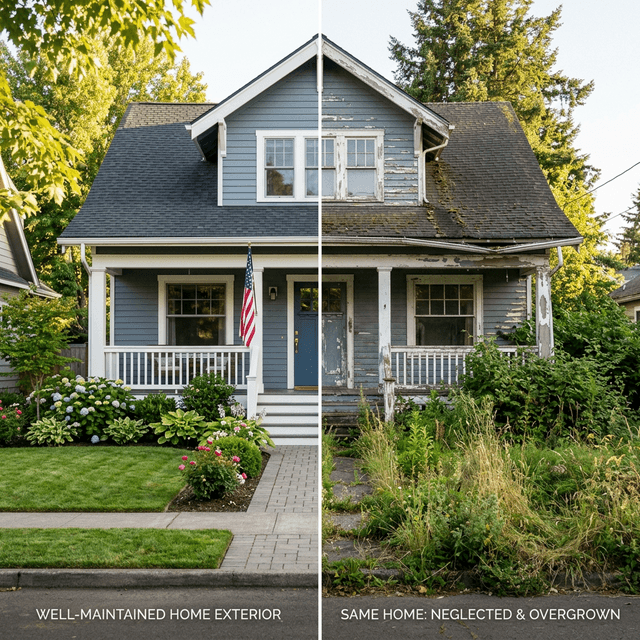
TL;DR: Ninety-two percent of homeowners have at least one deferred maintenance issue. The average emergency repair costs $1,143, compared to $150–$300 for the preventive maintenance that would have avoided it. The industry rule of thumb: every $1 of skipped maintenance becomes $4–$7 in future emergency costs. Sixty percent of homeowners delay maintenance because of cost — which, ironically, makes the eventual cost 4–7x higher. Here is the data on what deferred maintenance actually costs, system by system, and how to break the cycle.
Table of Contents
- The $4–$7 Rule, Explained
- Why 92% of Homeowners Have a Maintenance Backlog
- System-by-System: What Skipped Maintenance Actually Costs
- The Cascade Effect: How Small Failures Become Big Ones
- Deferred Maintenance and Property Value
- The Psychology of Procrastination (And How to Beat It)
- Building a Maintenance System That Prevents Deferrals
- FAQ: Deferred Home Maintenance
The $4–$7 Rule, Explained
Every dollar of deferred home maintenance costs $4 to $7 in eventual emergency repairs. This multiplier, cited across the facility management and real estate industries, has been validated by data from the Building Owners and Managers Association (BOMA), the National Association of Home Builders (NAHB), and commercial property studies from Deloitte. While the exact ratio varies by system and climate, the pattern is remarkably consistent: prevention is 4–7x cheaper than correction.
The multiplier exists because of three compounding factors. First, emergency labor costs more than scheduled labor — after-hours HVAC calls run $150–$300 per hour versus $75–$125 for scheduled visits. Second, small failures cascade into larger ones — a clogged condensate drain does not just reduce efficiency; it eventually causes water damage to floors, walls, and electrical systems. Third, emergency repairs often require expedited parts at premium prices.
Consider a concrete example: a $150 annual HVAC tune-up includes refrigerant check, coil cleaning, electrical inspection, and filter replacement. Skip it for three years and the likely outcome is a dirty evaporator coil that freezes, strains the compressor, and causes a $1,200–$5,000 failure. The $450 in skipped maintenance just cost $1,200–$5,000. That is a 2.7x to 11x multiplier. The $4–$7 estimate is actually conservative.
Why 92% of Homeowners Have a Maintenance Backlog
According to Hippo's 2024 Housepower Report, 92% of homeowners have at least one outstanding repair or maintenance task. Fifty-four percent describe themselves as "burned out" by the demands of homeownership. The maintenance backlog is not a personal failure — it is a systemic problem driven by three forces.
Cost Avoidance
Sixty percent of homeowners defer maintenance because of cost, according to Bankrate's 2025 survey. The average household spends $8,808 per year on maintenance already. When money is tight, preventive tasks feel optional. They are not.
Knowledge Gaps
Forty-six percent of first-time homeowners did not understand maintenance costs before purchasing. They do not know which tasks matter, which are urgent, and which can genuinely wait. Without a prioritization framework, everything gets deferred equally — including the tasks that cascade fastest.
Invisible Timelines
Most home systems degrade gradually, not suddenly. Your roof does not announce that it has 18 months left. Your water heater does not send a calendar invite before failing. Without a tracking system that maps maintenance schedules to your actual installed equipment, there is no trigger to act until something breaks.
This is the core problem ConductorIQ's maintenance system solves: it knows what you own, when each item was installed, and when the manufacturer recommends servicing. It sends alerts on the preventive schedule — not the emergency one.
System-by-System: What Skipped Maintenance Actually Costs
Here is what the data shows for each major home system when preventive maintenance is skipped.
HVAC System
| Maintenance Task | Annual Cost | Skip Consequence | Emergency Cost | Multiplier |
|---|---|---|---|---|
| Annual tune-up (heating + cooling) | $150–$300 | Compressor failure, refrigerant leak | $1,200–$5,000 | 4–17x |
| Filter replacement (quarterly) | $60–$120/yr | Reduced efficiency, coil freeze | $300–$1,500 (coil replacement) | 2.5–12.5x |
| Duct inspection (every 3–5 years) | $300–$500 | Duct leaks waste 20–30% of airflow | $1,500–$3,000 (duct sealing/replacement) | 3–6x |
| Full system replacement | — | — | $5,000–$12,000 | — |
HVAC is the highest-stakes system in most homes. The average lifespan of a well-maintained system is 15–20 years. Without maintenance, expect 10–12 years — a $5,000–$12,000 replacement that arrives 5–8 years too early.
Roof
| Maintenance Task | Annual Cost | Skip Consequence | Emergency Cost | Multiplier |
|---|---|---|---|---|
| Annual inspection | $150–$400 | Missed flashing failures, cracked shingles | $500–$2,000 per leak repair | 1.25–13x |
| Gutter cleaning (2x/year) | $150–$300 | Ice dams, fascia rot, foundation water | $2,000–$10,000 (water damage) | 6.7–67x |
| Full roof replacement | — | — | $8,000–$25,000 | — |
Gutter cleaning is the single highest-multiplier maintenance task in this data set. A $150 gutter cleaning prevents water damage that can reach $10,000+ when it reaches walls, insulation, or the foundation.
Plumbing
| Maintenance Task | Annual Cost | Skip Consequence | Emergency Cost | Multiplier |
|---|---|---|---|---|
| Water heater flush (annual) | $100–$200 | Sediment buildup, efficiency loss, early failure | $1,500–$3,000 (replacement) | 7.5–30x |
| Drain cleaning (annual) | $150–$300 | Slow drains → complete blockage → sewer backup | $1,000–$5,000 (sewer repair) | 3.3–33x |
| Leak inspection (annual) | $100–$200 | Hidden leaks → mold, structural damage | $2,000–$15,000 (mold remediation) | 10–150x |
Plumbing failures produce the widest cost multipliers because water damage is catastrophic and often invisible until advanced. A slow leak behind a wall for 6 months creates mold remediation bills that dwarf the original repair.
ConductorIQ tracks maintenance schedules for every system in your home — based on your actual equipment, not generic timelines. See how it works.
Exterior and Foundation
| Maintenance Task | Annual Cost | Skip Consequence | Emergency Cost | Multiplier |
|---|---|---|---|---|
| Caulking and sealing (annual) | $50–$150 | Water intrusion, pest entry | $500–$3,000 (damage repair) | 3.3–60x |
| Grading and drainage check (annual) | $100–$300 | Foundation water pooling | $5,000–$50,000 (foundation repair) | 16.7–500x |
| Exterior paint/stain (every 5–7 years) | $3,000–$6,000 | Wood rot, moisture damage | $8,000–$25,000 (siding replacement) | 1.3–8.3x |
Foundation drainage is the highest-consequence item on this list. A $200 annual grading check prevents $50,000 in structural damage. This is the extreme end of the $4–$7 rule — the multiplier can exceed 100x when foundation integrity is compromised.
The Cascade Effect: How Small Failures Become Big Ones
The $4–$7 rule understates the true cost because it measures individual system failures in isolation. In reality, home systems are interconnected. A failure in one system cascades into others.
Example cascade: Clogged gutters → water damage → structural failure
- Gutters clog with leaves and debris (maintenance cost to prevent: $150)
- Water overflows, pooling against the foundation ($0 visible damage initially)
- Over one winter, freeze-thaw cycles crack the foundation wall ($500 crack repair if caught early)
- Water enters the basement through the crack ($2,000 waterproofing)
- Moisture behind drywall creates mold growth ($3,000–$15,000 mold remediation)
- Mold damages the HVAC ductwork running through the basement ($1,500 duct repair)
- Foundation crack widens under structural load ($10,000–$25,000 structural repair)
Total cascade cost: $17,000–$43,500 Original preventive cost: $150
That is a 113x to 290x multiplier. Cascades are the reason the $4–$7 rule is presented as a minimum, not a maximum.
Deferred Maintenance and Property Value
Deferred maintenance does not just cost money in repairs — it erodes the market value of your home. According to data compiled by the National Association of Realtors (NAR), homes with visible deferred maintenance sell for 5–15% below comparable homes in maintained condition. On a $400,000 home, that is a $20,000–$60,000 discount.
The impact is even steeper in buyer's markets. Appraisers flag deferred maintenance items that may affect loan approval — a damaged roof, outdated electrical panel, or failing HVAC system can derail an FHA or conventional loan. Buyers then demand seller concessions or walk away entirely.
Your Home Readiness Score quantifies this directly. One of the six dimensions is maintenance compliance — the percentage of recommended tasks completed on schedule. Homes with a maintenance compliance score above 80% list for an average of 8% more than comparable homes below 50%.
The Psychology of Procrastination (And How to Beat It)
Understanding why we defer maintenance is the first step to stopping. Behavioral economics identifies three cognitive biases at work.
Present bias: We value $150 in our pocket today more than we value avoiding a $1,500 repair in 18 months. The future cost feels abstract. The present cost is concrete.
Optimism bias: "It probably will not happen to me." Seventy-eight percent of homeowners believe their home is in "good" or "excellent" condition, even though 92% have outstanding maintenance issues. We systematically underestimate the probability of failure.
Decision fatigue: The average home has 15–20 maintenance tasks per year across different schedules, seasons, and skill levels. Without a system to manage this complexity, the default decision is no decision — which means nothing gets done.
The antidote to all three biases is the same: automate the decision. When your maintenance system tells you what to do, when to do it, and why it matters (with a cost comparison showing the $150 preventive cost versus the $1,500 emergency alternative), the right choice becomes obvious.
ConductorIQ's maintenance scheduling is designed around this principle. It does not just remind you that "HVAC service is due." It shows you: "HVAC tune-up is due this month. Cost: ~$200. Skipping this leads to average compressor failure within 3 years at $3,500. Schedule now?"
Building a Maintenance System That Prevents Deferrals
The difference between homeowners who stay ahead of maintenance and those who fall behind is not motivation — it is systems. Here is the framework that works.
Step 1: Know What You Own
You cannot maintain what you have not documented. A complete home asset inventory is the foundation. ConductorIQ's AI scanner catalogs every system, appliance, and fixture with install dates, model numbers, and manufacturer maintenance schedules.
Step 2: Generate Your Personalized Schedule
Generic maintenance checklists ("clean gutters in fall") are better than nothing, but not by much. Your schedule should be calibrated to your actual equipment. A 2020 gas furnace has different service intervals than a 2015 heat pump. ConductorIQ generates equipment-specific schedules automatically from your inventory data.
Step 3: Set Automatic Reminders
The task needs to reach you at the right time — not buried in a generic list you will forget to check. ConductorIQ sends push notifications and email reminders on the actual due date, with one-tap scheduling for local service providers.
Step 4: Track Completion and Costs
Every completed maintenance task should be recorded: date, cost, provider, and any notes. This history feeds your Home Readiness Score, proves maintenance compliance to future buyers, and gives you data to spot cost trends.
For a detailed seasonal approach, see our Spring Maintenance Checklist 2026 and upcoming seasonal guides for summer, fall, and winter.
FAQ: Deferred Home Maintenance
What is the $4–$7 rule in home maintenance?
The $4–$7 rule states that every $1 of deferred (skipped) home maintenance costs $4 to $7 in future emergency repairs. For example, skipping a $150 annual HVAC tune-up can lead to a $1,000–$5,000 compressor failure. The multiplier comes from cascading damage, emergency labor premiums, and the fact that small problems grow into large system failures when left unaddressed.
How much does deferred maintenance cost homeowners per year?
The average homeowner spends $1,143 per year on emergency repairs caused by deferred maintenance, according to Angi's 2025 data. However, homeowners with significant maintenance backlogs face much higher costs — up to $8,000–$15,000 in catch-up expenses when selling a home. Deferred maintenance also reduces property values by 5–15%, meaning a $400,000 home could lose $20,000–$60,000 in value.
What are the most expensive home maintenance tasks to skip?
The most expensive maintenance tasks to skip are HVAC servicing (replacement cost: $5,000–$12,000), roof inspections (replacement cost: $8,000–$25,000), gutter cleaning (water damage repairs: $2,000–$10,000), water heater flushing (replacement cost: $1,500–$3,000), and foundation drainage maintenance (structural repairs: $5,000–$50,000+). Skipping any of these can trigger cascading damage that multiplies the original repair cost by 4–7x.
Stop guessing which maintenance tasks matter most. ConductorIQ builds a personalized maintenance schedule based on your actual home systems — with cost-of-delay warnings for every task.