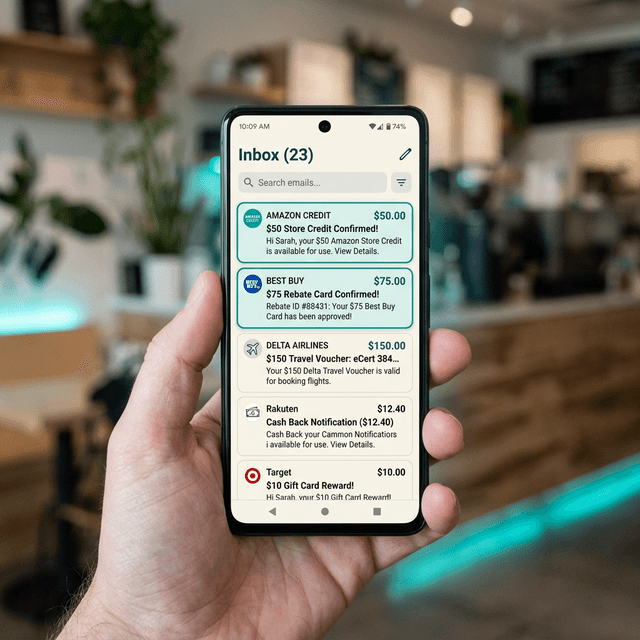
TL;DR: Americans lose over $21 billion per year in unredeemed credits. Your email inbox holds the evidence — store credits, travel vouchers, rebates, cashback, loyalty points, subscription credits, and gift cards you forgot about. The average household has $200–$1,200 sitting in various accounts, and most of it can be recovered with a simple email search or an AI scanning tool. Here are the 7 types to look for.
Table of Contents
- Why Your Inbox Is a Financial Blind Spot
- Type 1: Store Credits from Returns
- Type 2: Unused Gift Cards and E-Gift Cards
- Type 3: Travel Vouchers and Airline Credits
- Type 4: Rebate Payments You Never Claimed
- Type 5: Cashback and Rewards Balances
- Type 6: Subscription Credits and Proration Refunds
- Type 7: Loyalty Program Points Approaching Expiration
- How to Find These Credits in Your Email (Manual Method)
- How AI Finds Credits You Would Miss
- FAQ: Credits Hiding in Your Email
Why Your Inbox Is a Financial Blind Spot
Americans leave over $21 billion in unredeemed gift cards and credits on the table every year, according to CashStar and Mercator Advisory Group data. That figure only counts gift cards. Add store credits, travel vouchers, rebates, and loyalty points, and the real number is significantly higher. The common thread connecting all of these lost dollars is a single location: your email inbox.
Every credit, voucher, and reward you receive generates a confirmation email. That email gets read once — maybe — and then buried under a daily avalanche of newsletters, receipts, and promotions. Three months later, you have forgotten it exists. Six months later, it may have expired. The money was always there. The reminder system was not.
This is not a discipline problem. It is an information architecture problem. The average person receives 121 emails per day, according to Radicati Group. Important financial notifications are indistinguishable from noise. What you need is not a better inbox — it is a system that extracts, categorizes, and tracks financial value from your email automatically. That is exactly what ConductorIQ's Vault was built to do.
Here are the seven types of credits most likely hiding in your inbox right now.
Type 1: Store Credits from Returns
When you return an item to most retailers, the refund does not always go back to your original payment method. Many retailers issue store credits — especially for returns without a receipt, returns outside the standard window, or exchanges where the replacement costs less. These credits arrive via email as a barcode, a code, or a digital balance notification.
Average value per credit: $25–$75
Where to search: Look for emails from major retailers containing phrases like "store credit," "merchandise credit," "return credit," or "exchange credit." Retailers that commonly issue email-based store credits include Target, Nordstrom, Zara, H&M, Lululemon, and Wayfair.
Expiration risk: Varies by retailer. Some never expire (Nordstrom). Others expire in 90 days to 1 year. Unlike gift cards, store credits from returns are not protected by the federal CARD Act, so retailers have more latitude on expiration terms.
Recovery tip: Search your Gmail for subject:(store credit OR merchandise credit OR return credit) and sort by date. Check balances on any active credits before your next purchase at that retailer.
Type 2: Unused Gift Cards and E-Gift Cards
This is the big one. Americans hold over $23 billion in unused gift cards at any given time. Forty-seven percent of adults have at least one unused gift card, with an average value of $187 per person. E-gift cards are especially prone to getting lost because they exist only as emails — no physical card to find in a drawer.
Average value per card: $25–$50 (but ranges from $5 to $500+)
Where to search: Look for emails containing "gift card," "e-gift card," "egift," or "gift certificate." Check emails from Amazon, Visa, Mastercard, Starbucks, Apple, and any retailer you frequent.
Expiration risk: Federal law (CARD Act of 2009) requires a minimum 5-year expiration on gift cards. Some states have stronger protections — California, for example, prohibits expiration entirely for cards over $10. However, inactivity fees can erode value after 12 months of non-use.
Recovery tip: For a complete guide on organizing and tracking your gift cards, see how to track gift cards so you never lose money again.
ConductorIQ's Vault scans your email for gift cards automatically — surfacing balances, expiration dates, and sending alerts before credits expire. See how it works.
Type 3: Travel Vouchers and Airline Credits
Flight cancellations, schedule changes, and rebooking create travel credits that airlines, hotels, and online travel agencies (OTAs) issue via email. These credits often have strict expiration windows — typically 12 months from the date of issue — and complex redemption rules.
Average value per voucher: $100–$600
Where to search: Look for emails from airlines (Delta, United, American, Southwest, JetBlue), hotel chains (Marriott, Hilton, IHG), and OTAs (Expedia, Booking.com, Kayak) containing "travel credit," "future flight credit," "voucher," "travel funds," or "rebooking credit."
Expiration risk: High. Most airline credits expire within 12 months. Some pandemic-era policies extended this, but those extensions have largely ended. Hotel credits vary: Marriott Bonvoy points do not expire with account activity, but promotional credits often have hard deadlines.
Recovery tip: Create a simple reminder system for any travel credits over $50. Or let ConductorIQ's Vault track them automatically — it reads the expiration date from the email and sends a 30-day advance alert.
Type 4: Rebate Payments You Never Claimed
Product rebates — especially for home appliances, electronics, and energy-efficient upgrades — require you to submit a claim within a specific window. The confirmation email sits in your inbox. The check or prepaid card arrives weeks later, often in an envelope that looks like junk mail. If you missed the submission, the money is still potentially claimable within the original window.
Average value per rebate: $20–$200 (energy-efficient appliance rebates can reach $500+)
Where to search: Look for emails containing "rebate," "mail-in rebate," "rebate confirmation," "rebate status," or "claim your rebate." Common sources include appliance manufacturers (Whirlpool, GE, LG), utility companies (energy efficiency rebates), and electronics retailers.
Expiration risk: Most rebates have a 30–90 day submission window from purchase. If the window has passed, you cannot recover the money. But many people submit their rebate and then forget to check for the payment — search for "rebate check" or "rebate card" to find unclaimed payouts.
Recovery tip: If you have recently purchased a major appliance for your home, check the manufacturer's rebate portal. Many energy-efficient upgrades (heat pumps, smart thermostats, insulation) qualify for federal, state, and utility rebates under the Inflation Reduction Act. These can total thousands of dollars for qualifying homeowners.
Type 5: Cashback and Rewards Balances
Credit card cashback rewards, shopping portal credits, and app-based rewards accumulate silently. Your credit card may have $50–$300 in unclaimed cashback sitting in your account right now. Shopping portals like Rakuten, Honey, and Capital One Shopping issue quarterly payouts — but only if your balance exceeds a minimum threshold.
Average unclaimed value: $50–$300 per account
Where to search: Look for emails from your credit card issuers mentioning "cashback," "rewards balance," "redeem your rewards," or "statement credit available." Check shopping portal emails from Rakuten, Honey, and RetailMeNot for pending cashback notifications.
Expiration risk: Credit card cashback generally does not expire while the account is open. But promotional bonus rewards (spend $500, get $100) often have activation deadlines. Shopping portal payouts can be forfeited if your account goes inactive for 12+ months.
Recovery tip: Log into each credit card's rewards portal quarterly. Set calendar reminders for promotional spending thresholds. For Amex Platinum and Gold cardholders, ConductorIQ tracks your monthly credits (dining, streaming, airline incidentals) to ensure you use every dollar of your annual benefits.
Type 6: Subscription Credits and Proration Refunds
When you downgrade, cancel, or are overcharged on a subscription service, the provider often issues a prorated credit. These credits show up as emails saying "your account has been credited" or "your credit will be applied to your next billing cycle." If you canceled the subscription entirely, that credit may go unused permanently.
Average value per credit: $5–$50
Where to search: Look for emails from subscription services (streaming, software, cloud storage, meal kits, gym memberships) containing "account credit," "proration," "billing adjustment," or "credit applied."
Expiration risk: Credits applied to active accounts are typically used automatically on the next billing cycle. Credits on canceled accounts may expire within 30–90 days, or the company may require you to contact support to receive a refund instead.
Recovery tip: If you have canceled any subscriptions in the past 6 months, search your email for those companies plus the word "credit." You may have a balance that can be refunded to your payment method by contacting customer support.
Type 7: Loyalty Program Points Approaching Expiration
Loyalty points from airlines, hotels, retailers, and restaurants accumulate across dozens of programs. Most people are active in 2–3 programs but enrolled in 12 or more. The dormant programs quietly expire points while you are not looking.
Average value at risk: $50–$500 per household per year
Where to search: Look for emails containing "points expiring," "points balance," "use your points," "account inactive," or "loyalty update" from airlines, hotels (Marriott, Hilton, IHG), retailers (Best Buy, Sephora, Ulta), and restaurants (Starbucks, Chick-fil-A, Chipotle).
Expiration risk: High. Most loyalty programs expire points after 12–24 months of account inactivity. Some programs (like airline miles) have shifted to activity-based expiration — a single small transaction resets the clock. Others have hard date expirations regardless of activity.
Recovery tip: The cheapest way to prevent loyalty point expiration is a minimal transaction. Buy a $1 item through the retailer's online portal or earn a single point through a partner activity. This resets the inactivity timer for most programs.
How to Find These Credits in Your Email (Manual Method)
If you want to do a one-time email audit, here is the fastest manual approach:
Step 1: Open Gmail and search for: (gift card OR store credit OR travel credit OR voucher OR rebate OR cashback OR rewards OR points expiring) — filter results to the past 12 months.
Step 2: Scan the results. Open any email that looks like a credit notification. Note the amount, issuer, and any expiration date.
Step 3: Create a simple tracking list: issuer, credit type, amount, expiration date.
Step 4: Set calendar reminders for any credits expiring within the next 90 days.
Estimated time: 30–60 minutes for a thorough search. Most people find $200–$500 on the first pass.
The problem with the manual method: it is a snapshot. New credits arrive constantly. Without an automated system, you will need to repeat this process regularly — and most people do not.
How AI Finds Credits You Would Miss
ConductorIQ's Vault connects to your Gmail account (with your explicit permission, using read-only OAuth access) and continuously scans for financial value. It does not just search for keywords — it uses natural language processing to understand context. A rebate confirmation from 7 months ago. A travel voucher buried in a thread. A gift card forwarded from a family member with a different subject line.
The Vault categorizes each credit by type, extracts the amount and expiration date, and adds it to your financial recovery dashboard. You get a single view of every dollar available to you — and alerts when any credit is approaching expiration.
Our users recover an average of $1,200 per year in credits they would have otherwise lost. For homeowners managing multiple credit cards, loyalty programs, and appliance warranties, that number is often higher.
The Vault is part of the ConductorIQ platform alongside home asset tracking, warranty management, and maintenance scheduling. Every financial and maintenance detail about your home and your household, in one place.
FAQ: Credits Hiding in Your Email
How much money do most people have in forgotten credits?
The average American household has between $200 and $1,200 in forgotten or overlooked credits across email accounts. This includes unused gift cards (average $187 per person), store credits from returns, travel vouchers, rebate payments, subscription credits, cashback rewards, and loyalty points. The total depends on purchasing patterns and how many accounts you hold.
Do store credits expire?
Store credit expiration varies by retailer and state. Some retailers issue store credits that never expire, while others set 90-day to 1-year windows. Gift cards are protected by federal law (CARD Act) with a minimum 5-year expiration, but store credits from returns are not covered by the same regulation. Always check the terms on your specific credit.
Can AI scan my email to find forgotten credits?
Yes. AI-powered tools like ConductorIQ's Vault feature can connect to your Gmail account and scan for credit-related emails — gift card confirmations, store credit notifications, rebate approvals, and travel vouchers. The AI identifies the credit type, amount, and expiration date, then organizes everything in a dashboard with alerts before credits expire.
Stop losing money to forgotten credits. ConductorIQ's Vault scans your email, finds hidden value, and sends alerts before anything expires.