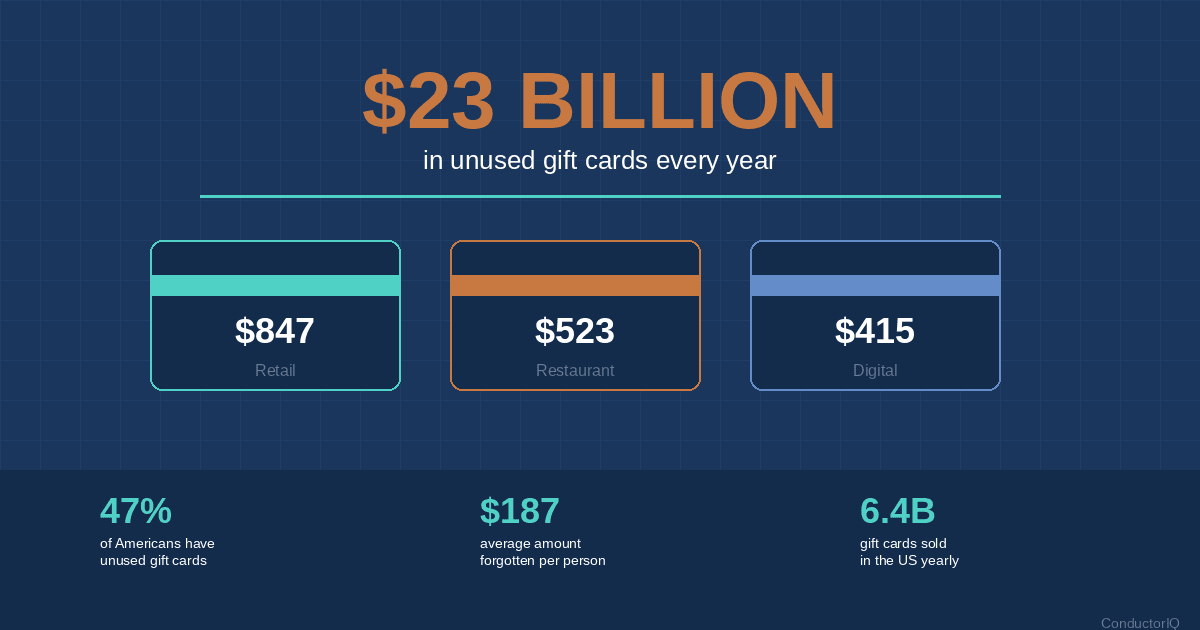
TL;DR: Americans are sitting on over $23 billion in unused gift cards. Nearly half of all U.S. adults have at least one unredeemed card collecting dust, with the average person holding $244 in forgotten value. The money doesn't vanish — it becomes profit for corporations. Here's what the data reveals and how to fight back.
Table of Contents
- The Scale of the Problem: $23 Billion and Climbing
- Who Loses the Most? A Demographic Breakdown
- The Five Reasons Gift Cards Go Unused
- Corporate Breakage: How Companies Profit From Your Forgetfulness
- Gift Card Scams: The $148 Million Side Problem
- What the Law Says: Federal and State Protections
- The Solution: Automated Tracking Beats Human Memory
- FAQ: Unused Gift Card Statistics
The Scale of the Problem: $23 Billion and Climbing
The number is difficult to process. Americans collectively hold between $23 billion and $27 billion in unused gift cards at any given time, according to consecutive annual surveys by Bankrate. That figure isn't a one-time measurement. It's a rolling balance that replenishes every holiday season, birthday, and corporate incentive program.
In 2023, Bankrate found that 47% of U.S. adults — nearly half the country — had at least one unspent gift card or voucher, with an average value of $187 per person. One year later, the percentage dipped slightly to 43%, but the average unredeemed balance per person surged to $244. That's a 30.5% increase in the dollar amount people are leaving on the table.
To put this in context: over the past decade, Americans have purchased more than $1 trillion in gift cards. Between 10% and 19% of that value remains unredeemed at any given moment. Roughly 6% of all gift cards are never used at all.
That $50 Starbucks card in your kitchen drawer? It has roughly 160 million companions across the country.
Who Loses the Most? A Demographic Breakdown
Gift card forgetfulness doesn't hit every demographic equally. The Bankrate data reveals a counterintuitive pattern: the more money you earn, the more gift card value you waste.
By income bracket:
- Households earning $100,000+ per year: 55% have unused gift cards, with an average balance of $348
- Households earning under $50,000 per year: 35% have unused cards, averaging $180
That 20-percentage-point gap suggests that wealthier households treat gift cards as low-priority — a $25 Target card doesn't register as urgent when you're not watching every dollar. For lower-income households, a gift card represents real spending power.
By generation:
- Millennials hold the highest average unredeemed balance: $322 per person
- Gen X follows at $255
- Baby Boomers average $227
- Gen Z trails at $142
Millennials' outsized balances likely reflect their position in peak gift-receiving years (birthdays, weddings, baby showers) combined with busy schedules that make redemption an afterthought. They're old enough to accumulate cards and busy enough to forget them.
The Five Reasons Gift Cards Go Unused
When researchers ask consumers why their gift cards remain unredeemed, the same reasons surface repeatedly. More than one in three Americans (34%) have lost money due to a gift card misstep, according to Bankrate's 2024 survey.
Here's where the value disappears:
1. Expiration (20% of recipients)
One in five gift card holders has let at least one card expire before redeeming it. Despite federal protections requiring a five-year minimum lifespan, promotional gift cards, store credits from returns, and experience-based certificates often carry shorter windows. People tuck the card away "for later," and later never comes.
2. Forgetfulness (19% of recipients)
The Retail Gift Card Association found that nearly one in five recipients simply forget they have the card. It goes into a wallet pocket, a desk drawer, or a stack of mail — and vanishes from working memory. A third of consumers in 2024 admitted to outright forgetting about gift cards entirely.
3. Loss (15-17% of recipients)
Physical cards get lost. They fall behind couch cushions. They go through the washing machine. E-gift cards fare slightly better but still get buried in email inboxes under hundreds of promotional messages. If you've ever searched "gift card" in your Gmail and been surprised by what turned up, you're not alone. (We wrote about that phenomenon here.)
4. Business closures (12% of recipients)
When a retailer shuts down, outstanding gift card balances typically become unsecured debt — meaning cardholders are at the back of the line in bankruptcy proceedings. The wave of retail closures in recent years has accelerated this problem.
5. Partial balances left behind
This one doesn't show up as a clean survey response, but it's pervasive. You use $43 of a $50 card and never go back for the remaining $7. Multiply that by hundreds of millions of cards in circulation and the residual value is staggering.
The common thread? Every one of these failures is a tracking problem, not a spending problem. People want to use their gift cards. They just lose track of them.
Corporate Breakage: How Companies Profit From Your Forgetfulness
When you buy a gift card, the retailer records it as a liability on their balance sheet — money they owe the cardholder. But when that card never gets redeemed, that liability quietly transforms into revenue through an accounting mechanism called breakage.
Breakage is enormously profitable. Consider these numbers:
- Starbucks holds an estimated $1.77 billion in unredeemed gift card funds and recognizes roughly $200 million per year in breakage revenue
- Best Buy reported $37 million in breakage income in a single year
- Home Depot booked $34 million
- Chipotle estimates that 4% of its gift cards are never redeemed
Under ASC 606 accounting standards (adopted in 2019), companies can begin recognizing breakage revenue proportionally as cards are partially redeemed, rather than waiting for full expiration. This means your forgotten $25 card starts generating corporate profit long before its official expiration date.
The scale is hard to overstate. From 2005 to 2015 alone, unredeemed gift card balances totaled $45.7 billion — money that transferred from consumers to corporate balance sheets because people couldn't keep track of a small piece of plastic.
This isn't a design flaw. For many retailers, breakage is a feature of their gift card programs.
Gift Card Scams: The $148 Million Side Problem
Beyond the billions lost to forgetfulness, gift cards have become the number-one payment method demanded by scammers. The Federal Trade Commission has flagged this as a growing crisis.
In the first nine months of one recent reporting period, consumers lost $148 million to gift card scams, with gift cards appearing in 25% of all fraud reports. The median loss per victim: $1,000.
The most commonly exploited cards:
- Apple gift cards: 30% of reported scam cases
- Target gift cards: 14% of cases but the highest average loss per victim
A newer threat — gift card draining — targets cards before they're even purchased. Scammers record card numbers and PINs from cards on retail shelves, reseal the packaging, and wait for an unsuspecting buyer to load the card with funds. The balance is stolen within minutes of activation.
The FTC's guidance is blunt: gift cards are for gifts, not payments. No legitimate business, government agency, or law enforcement body will ever request payment via gift card. But the scam economy thrives because gift cards are untraceable, non-reversible, and instantly convertible.
Tracking your cards digitally — with encrypted storage of card numbers and PINs — doesn't just help you remember to use them. It creates a record that can help if fraud occurs.
What the Law Says: Federal and State Protections
Federal law provides a baseline, but the protections vary dramatically by state.
Federal: The CARD Act of 2009
The Credit Card Accountability Responsibility and Disclosure Act established three core protections:
- Gift cards cannot expire within five years of the date of issuance
- Inactivity fees cannot be charged until a card has been inactive for at least 12 months
- All fees and expiration dates must be clearly disclosed on the card or its packaging
These rules apply to general-purpose gift cards and store-branded gift cards. They do not cover promotional gift cards, loyalty rewards, or experience-based certificates — which is where many consumers get caught off guard.
State laws: A patchwork of stronger protections
Several states go further than federal minimums:
- California and Florida prohibit gift card expiration dates entirely
- New York requires gift cards to remain valid for nine years
- California allows cash redemption for any balance under $10
- Colorado, Maine, Montana, New Jersey, Oregon, and Washington allow cash redemption for balances under $5
Additionally, at least 19 states require retailers to turn over unredeemed gift card balances to the state's unclaimed property program after a dormancy period — typically three to five years. That money can then be claimed by consumers through state unclaimed property databases.
The practical problem? Almost nobody knows which rules apply to their specific cards. A gift card purchased in California has different protections than one bought in Texas, regardless of where the recipient lives. That complexity is one more reason cards go unused — people aren't sure what their rights are, so they do nothing.
For a deeper look at how your overall financial readiness stacks up, check out our Home Readiness Score guide.
The Solution: Automated Tracking Beats Human Memory
The data tells a clear story. People don't waste gift cards because they don't care about the money. They waste them because human memory is not designed to track dozens of small-balance financial instruments with varying expiration dates stored across physical wallets, email inboxes, and desk drawers.
Manual solutions — spreadsheets, notes apps, photo albums of card numbers — help in theory but fail in practice because they require ongoing effort. The card arrives, you tell yourself you'll log it later, and you never do.
This is why we built The Vault inside ConductorIQ. It's an AI-powered system that connects to your Gmail and automatically scans incoming emails for gift card confirmations, store credit notifications, travel vouchers, and promotional balances. No manual entry required.
Here's what The Vault does:
- Detects gift cards and store credits from email confirmations automatically
- Extracts redemption codes, balances, and expiration dates
- Stores all card data with AES-256 encryption — the same standard used by banks and government agencies
- Sends SMS alerts at 30, 7, and 1 days before any card expires
- Centralizes everything in a single dashboard so you can see your total recoverable balance at a glance
The average Vault user recovers $1,200 per year in gift cards, store credits, and vouchers that would have otherwise expired or been forgotten. That's not a hypothetical number. It's what happens when you remove human memory from the equation and let automation handle tracking.
If you're curious about the broader category of money hiding in your inbox, read our breakdown of credits hiding in your email. And for a comparison of tracking approaches, see our guide to gift card tracking apps.
FAQ: Unused Gift Card Statistics
How much money is wasted on unused gift cards each year?
Americans collectively hold between $21 billion and $27 billion in unused gift cards at any given time, according to Bankrate surveys from 2023 and 2024. The average person carries $244 in unredeemed gift card value. An estimated $3 billion in gift card value is permanently lost each year due to expiration, card loss, or business closures.
What percentage of gift cards go unused?
Between 10% and 19% of all gift card balances remain unredeemed at any given time, and approximately 6% of gift cards are never used at all. As of 2024, 43% of American adults report having at least one unused gift card, voucher, or store credit.
Do gift cards expire under federal law?
Under the federal CARD Act of 2009, gift cards cannot expire within five years of the date of issuance. Inactivity or dormancy fees cannot be charged until a card has been inactive for at least one year. However, many states enforce stricter protections — California and Florida, for example, prohibit gift card expiration dates entirely.
Why do people forget to use their gift cards?
The top reasons are: forgetting about the card (19% of recipients), losing the physical card (15-17%), letting it expire (20%), and the issuing business closing before redemption (12%). Higher-income individuals are more likely to have unused cards, with 55% of households earning $100,000+ reporting unredeemed balances.
How can I track gift cards so they don't go to waste?
The most effective approach is a digital tracking tool that centralizes all your gift cards, store credits, and vouchers with expiration alerts. ConductorIQ's Vault feature automatically scans your email for gift card confirmations, tracks expiration dates, sends SMS reminders at 30, 7, and 1 days before expiration, and stores redemption codes with AES-256 encryption. Learn more about how Vault saves the average user $1,200 per year.
Stop Leaving Money in the Drawer
That $244 sitting in your forgotten gift cards isn't a rounding error. It's a car payment. A month of groceries. A weekend trip.
The data is unambiguous: 43% of Americans are losing money not because they overspend, but because they can't keep track of what they've already been given. Corporations count on this. They've built breakage revenue into their financial models. Every forgotten card is profit on their balance sheet.
You don't have to be part of the $23 billion statistic.
Try ConductorIQ's Vault free for 30 days and find out how much money is hiding in your inbox right now. The average user discovers $1,200 in recoverable gift cards, store credits, and vouchers in their first scan. Your number might be higher.
No credit card required. No manual data entry. Just connect your email and let The Vault do the work.
Sources: Data cited in this article draws from Bankrate's 2024 Gift Card Survey, FTC Consumer Sentinel Network reports, PBS NewsHour reporting on gift card economics, and the National Conference of State Legislatures gift card statutes database. All statistics reflect the most recent available data as of March 2026.