Spring Home Maintenance Checklist 2026: 25 Tasks to Protect Your Home
Winter is behind you. The snow has melted, the days are getting longer, and your house just survived months of freezing temperatures, ice, wind, and moisture. Now is the time to assess the damage, prevent small problems from becoming expensive ones, and get your home ready for the warmer months ahead.
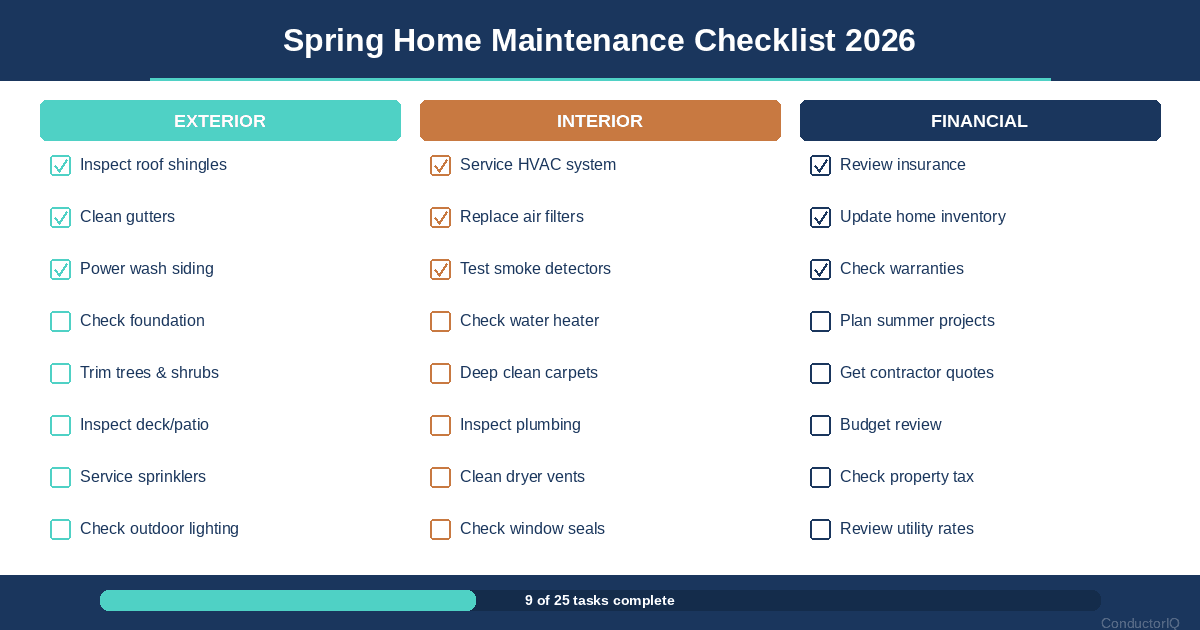
This is your complete spring home maintenance checklist for 2026 — 25 tasks organized into exterior, interior, and safety categories. Each task includes a time estimate, difficulty level, and clear guidance on whether you should handle it yourself or call a professional.
TL;DR — Why spring maintenance pays off: Preventive maintenance reduces overall repair costs by roughly 30%, according to industry research. The average homeowner spends $2,041 on planned maintenance versus $1,143 on emergency repairs each year (Angi). Spending a weekend on this checklist now can save you thousands in surprise bills later. Every dollar you put into preventive upkeep saves up to five dollars in unplanned fixes down the road.
Why Spring Maintenance Matters More Than You Think
Home maintenance costs have climbed 42% over the past five years, reaching an average of $8,808 per year in 2025 (HomeGuide). Labor now accounts for nearly 60% of total repair costs, and construction materials are projected to increase another 5-7% through 2026. The skilled trades workforce is shrinking, which means last-minute service calls are more expensive than ever.
The good news: most of the tasks on this checklist cost little or nothing to do yourself. The ones that need a professional are far cheaper when booked proactively rather than as emergencies.
Spring is the ideal window because you can catch winter damage before it worsens, prepare cooling systems before peak season, and take advantage of mild weather for outdoor work.
Exterior Tasks (10 Tasks)
Start outside. Structural and water-management systems should be addressed first because unresolved moisture problems undermine every other improvement you make.
1. Inspect the Roof
Look for missing, cracked, or curling shingles. Check flashing around chimneys, vents, and skylights for gaps or lifting. You do not need to climb onto the roof — binoculars or a phone camera with zoom work well from the ground. Look for dark streaks or moss growth, which signal trapped moisture.
Why it matters: Minor roof repairs cost $150 to $1,000. Ignoring them can lead to a full replacement at $8,000 to $13,000+ (HomeAdvisor).
2. Clean Gutters and Downspouts
Remove leaves, twigs, and sediment that accumulated over winter. Flush the entire system with a garden hose to check flow. Confirm gutters slope correctly toward downspouts, tighten loose hangers, and check seams for leaks. Make sure downspouts discharge water at least 4-6 feet away from the foundation.
Why it matters: Clogged gutters cause water to overflow against your foundation, rot fascia boards, and invite pests into your attic (Bob Vila).
3. Check the Foundation
Walk the perimeter of your home and look for new cracks, shifting, or water staining on foundation walls. Check basement walls and floors for discoloration, efflorescence (white mineral deposits), mildew, or musty smells. Small hairline cracks are usually cosmetic, but horizontal cracks or gaps wider than 1/4 inch need professional evaluation.
Why it matters: Foundation repair can cost up to $8,129 on average. Catching cracks early — when they can be sealed for under $500 — is far better than waiting.
4. Inspect and Repair the Deck or Patio
Check decking boards for rot, warping, splintering, or loose fasteners. Test railings for stability. Look for concrete cracks in patios and walkways. Late spring is the ideal time to power-wash and restain a wood deck — summer heat can cause stain to evaporate before it penetrates the wood (This Old House).
5. Assess Landscaping and Grading
Ensure the ground slopes away from your foundation on all sides. Winter freeze-thaw cycles can shift soil and create low spots where water pools against the house. Rake garden beds, remove dead growth, and add fresh mulch to suppress weeds and retain moisture. Trim any branches or shrubs touching the siding — they create bridges for pests.
6. Inspect Exterior Paint and Siding
Look for peeling, bubbling, or cracked paint. Check vinyl or fiber cement siding for warping, gaps, or holes. Damaged paint and siding allow moisture to reach the underlying structure, which leads to rot and mold. Touch up small areas now before they require full repainting.
7. Check Windows and Exterior Caulking
Inspect caulking around all windows, doors, and where different materials meet (e.g., siding to trim). Look for cracked, missing, or shrunken caulk. Check weatherstripping on doors and windows for gaps. If you had condensation between panes of double- or triple-glazed windows during winter, the seal has failed and the glass unit needs replacement.
Why it matters: A tight seal is the first line of defense against air infiltration. Leaking seals let cooled air escape in summer, driving up energy bills by 10-15%.
8. Power Wash Exterior Surfaces
Power wash siding, walkways, driveways, and patios to remove winter grime, mildew, and salt residue. Use appropriate pressure settings — too high and you can damage wood or strip paint. For most vinyl siding, 1,300-1,600 PSI is sufficient.
9. Service Outdoor Faucets and Irrigation
Turn on each outdoor faucet slowly and check for leaks or reduced flow, which may indicate a frozen pipe that cracked over winter. Run your sprinkler or irrigation system through every zone manually, walk the property, and verify no heads are broken, misaligned, or clogged.
10. Check Outdoor Lighting and Electrical
Test all exterior light fixtures, motion sensors, and GFCI outlets. Replace burned-out bulbs and reset any tripped GFCI breakers. Inspect outdoor wiring for fraying or damage from weather and animals.
Interior Tasks (10 Tasks)
With the exterior secured, move inside to prepare your home's mechanical systems, safety devices, and living spaces for the season ahead.
11. Schedule HVAC Service
Have a licensed HVAC technician service your air conditioning system before cooling season begins. A professional tune-up includes checking refrigerant levels, cleaning coils, inspecting electrical connections, and testing the thermostat. This typically costs $150-$350 and extends the life of your system by 5-10 years.
Why it matters: Neglecting HVAC maintenance can increase energy use by 20-30%, according to the U.S. Department of Energy. A $200 tune-up today prevents a $2,000+ compressor failure later (Angi).
12. Replace HVAC Filters
This is the single easiest task on the list. Pull out your air filter, check the size printed on the frame, and replace it. Standard disposable filters should be replaced every 1-3 months. If you have pets or allergies, consider upgrading to a MERV 11 or higher filter.
13. Flush the Water Heater
Sediment builds up at the bottom of your water heater tank over time, reducing efficiency and shortening the unit's lifespan. Attach a garden hose to the drain valve, run it to a floor drain or outside, and flush until the water runs clear. Check the pressure relief valve while you are at it — lift the lever briefly and confirm water flows, then let it snap back.
14. Test Smoke and Carbon Monoxide Detectors
Press the test button on every detector in your home. Replace batteries in all units — do not wait for the low-battery chirp. Smoke detectors should be replaced entirely every 10 years and carbon monoxide detectors every 5-7 years, as the sensors degrade over time regardless of battery status.
15. Inspect Plumbing for Leaks
Check under every sink, around toilets, and near the water heater for drips, moisture, or water stains. Run each faucet and flush each toilet. Look at exposed pipes in the basement or crawl space for corrosion or mineral buildup. A slow drip wasting one drop per second adds up to over 3,000 gallons per year.
16. Clean Dryer Vents
Disconnect the dryer vent hose and thoroughly clean lint from both the hose and the wall vent. Use a long-handled brush or a dryer vent cleaning kit. Lint buildup in dryer vents is one of the leading causes of house fires — this task is critical, not optional (Mr. Handyman).
17. Schedule a Pest Inspection
Termites swarm in spring, typically from March through June. Look for small piles of sawdust near baseboards, mud tubes on foundation walls, or winged insects emerging from woodwork. If you see any of these signs, call a licensed pest control company immediately. Even without visible signs, an annual termite inspection (usually $75-$150) is cheap insurance against structural damage.
18. Deep Clean and Inspect the Basement or Crawl Space
Check for signs of water intrusion: stains, mildew, standing water, or musty odors. If you have a sump pump, test it by pouring a bucket of water into the pit and verifying it activates and drains properly. This should be done before spring rains arrive.
19. Service Major Appliances
Clean refrigerator coils (underneath or behind the unit) to improve efficiency. Run a cleaning cycle on your dishwasher and washing machine. Check the garbage disposal for debris. Inspect the oven and range for worn gaskets or burners that do not ignite consistently.
20. Clean Windows, Screens, and Fans
Remove window screens, scrub them with mild soap and water, rinse, and let them dry before reinstalling. Clean windows inside and out. Wipe ceiling fan blades and switch rotation to counter-clockwise for warm-weather cooling. Clean bathroom exhaust fan covers — remove them and use compressed air to clear dust, which prevents mold growth.
Safety Tasks (5 Tasks)
These tasks take the least time but have the highest stakes. Do not skip them.
21. Update Your Emergency Kit
Check expiration dates on all supplies: water (replace every 6 months), food, medications, and batteries. Restock anything that has been used or expired. Your kit should include enough supplies for each household member for at least 72 hours, plus items for pets.
22. Inspect Fire Extinguishers
Verify the pressure gauge is in the green zone. Confirm the pin is in place and the nozzle is clear. Shake the canister to keep the dry chemical powder loose and prevent packing. Fire extinguishers should be replaced every 5-12 years depending on the type. You should have one on each level of your home and one in the kitchen and garage.
23. Refresh First Aid Supplies
Open your first aid kit and check for expired medications, dried-out ointments, and missing items. Restock bandages, antiseptic, pain relievers, allergy medication, and any prescription items. Add sunscreen and insect repellent for the warmer months.
24. Update Emergency Contact Information
Verify that your list of emergency contacts is current: family doctor, local hospital, poison control (1-800-222-1222), utility companies, insurance agent, and a trusted neighbor. Post the list in a visible location and save it in your phone. Make sure all family members know where to find it.
25. Review Your Home Insurance Policy
Spring is a natural time to review your coverage. Has your home's value changed? Have you made improvements that need to be added? Are you covered for the types of events common in your area (flooding, wind, hail)? A 15-minute call to your insurance agent can prevent a major gap in coverage when you need it most.
Printable Checklist Summary
| # | Task | Category | DIY or Pro | Est. Time | Priority |
|---|---|---|---|---|---|
| 1 | Inspect the roof | Exterior | DIY (visual) / Pro (repair) | 30 min | High |
| 2 | Clean gutters and downspouts | Exterior | DIY (1-story) / Pro (2+ story) | 1-3 hrs | High |
| 3 | Check the foundation | Exterior | DIY (inspect) / Pro (repair) | 30 min | High |
| 4 | Inspect deck or patio | Exterior | DIY | 1-2 hrs | Medium |
| 5 | Assess landscaping and grading | Exterior | DIY | 2-4 hrs | Medium |
| 6 | Inspect exterior paint and siding | Exterior | DIY (touch-up) / Pro (full repaint) | 1-2 hrs | Medium |
| 7 | Check windows and caulking | Exterior | DIY | 1-2 hrs | High |
| 8 | Power wash exterior surfaces | Exterior | DIY / Pro | 2-4 hrs | Low |
| 9 | Service outdoor faucets and irrigation | Exterior | DIY | 30-60 min | Medium |
| 10 | Check outdoor lighting and electrical | Exterior | DIY (bulbs) / Pro (wiring) | 30 min | Low |
| 11 | Schedule HVAC service | Interior | Pro | 1-2 hrs | High |
| 12 | Replace HVAC filters | Interior | DIY | 10 min | High |
| 13 | Flush the water heater | Interior | DIY | 30-60 min | Medium |
| 14 | Test smoke and CO detectors | Interior | DIY | 15 min | High |
| 15 | Inspect plumbing for leaks | Interior | DIY (inspect) / Pro (repair) | 30 min | High |
| 16 | Clean dryer vents | Interior | DIY | 30-45 min | High |
| 17 | Schedule pest inspection | Interior | Pro | 1 hr | Medium |
| 18 | Deep clean basement or crawl space | Interior | DIY | 1-2 hrs | Medium |
| 19 | Service major appliances | Interior | DIY | 1-2 hrs | Low |
| 20 | Clean windows, screens, and fans | Interior | DIY | 2-3 hrs | Low |
| 21 | Update emergency kit | Safety | DIY | 30 min | High |
| 22 | Inspect fire extinguishers | Safety | DIY | 10 min | High |
| 23 | Refresh first aid supplies | Safety | DIY | 15 min | Medium |
| 24 | Update emergency contacts | Safety | DIY | 10 min | Medium |
| 25 | Review home insurance policy | Safety | DIY | 15-30 min | Medium |
Total estimated time: 2-3 weekends (or about 20-30 hours spread across the season)
How Long Each Task Takes
Not every task needs to happen on the same weekend. Here is how to break them into manageable blocks.
Weekend 1 — Structural and Water Management (6-8 hours) Roof inspection, gutter cleaning, foundation check, grading assessment, and outdoor faucet testing. These protect your home from water damage and should be done first.
Weekend 2 — Mechanical Systems (3-5 hours) HVAC filter replacement, water heater flush, smoke and CO detector testing, dryer vent cleaning, and plumbing inspection. Schedule your professional HVAC tune-up for this week as well.
Weekend 3 — Exterior Refresh (5-8 hours) Deck inspection and staining, power washing, exterior paint touch-ups, window and caulking checks, and outdoor lighting.
Weekend 4 — Interior and Safety (4-6 hours) Deep cleaning, window and screen cleaning, appliance service, emergency kit update, fire extinguisher check, first aid restock, and insurance review. Schedule your pest inspection for this week.
Spreading the work across four weekends keeps each session manageable and prevents burnout.
DIY vs. Pro: Where to Spend Your Money
Knowing what to tackle yourself and what to hand off to a professional saves both money and headaches.
Tasks You Should Always DIY
- HVAC filter replacement — Takes 10 minutes, costs $10-$30 for the filter.
- Smoke and CO detector testing — Press a button, replace a battery. No tools needed.
- Fire extinguisher inspection — Check the gauge and shake the canister.
- Gutter cleaning (single-story homes) — A ladder, gloves, and a garden hose. Budget $20-$50 for a gutter scoop if you do not have one.
- Caulking windows and doors — A tube of exterior caulk costs $5-$10. Apply it in dry weather above 40 degrees F.
- Emergency kit and first aid restocking — Purely a shopping and organizing task.
Tasks Where a Pro Is Worth the Cost
- HVAC tune-up — $150-$350. Involves refrigerant handling, combustion testing, and electrical diagnostics. Requires licensing in most states.
- Roof repair — $150-$1,000 for minor fixes. Heights and proper material selection make this a safety and quality issue.
- Foundation repair — Varies widely. Structural work requires engineering knowledge and specialized equipment.
- Pest inspection — $75-$150. Licensed inspectors know where to look and can identify species-specific damage patterns.
- Gutter cleaning (multi-story homes) — $150-$400. The fall risk is not worth the savings. Professional crews typically cost about $237 on average (LeafFilter).
Tasks That Can Go Either Way
- Power washing — Renting a pressure washer costs $50-$100/day. Pros charge $200-$500 but know the right PSI settings for each surface.
- Deck staining — Materials cost $50-$150. A pro charges $500-$1,500 but gets it done in a day with commercial equipment.
- Water heater flush — Simple process, but if your drain valve is corroded or stuck, a plumber should handle it.
How ConductorIQ Makes This Easier
Staring at a 25-item checklist can feel overwhelming, even with the best intentions. That is the problem ConductorIQ was built to solve.
ConductorIQ's Spring Prep bundle loads all 25 tasks automatically into your personalized maintenance calendar. Each task arrives with a due date, time estimate, and clear instructions. As you complete them, your Home Readiness Score updates in real time — giving you a single number that tells you how well-maintained your home is.
Here is what the platform handles for you:
- Seasonal bundles — Spring Prep, Summer Prep, Fall Prep, and Winter Prep load the right tasks at the right time of year, tuned to your climate zone.
- Recurring task automation — Tasks like HVAC filter replacement, gutter cleaning, and detector testing are automatically rescheduled on the correct intervals. You never have to remember when something is due.
- Asset tracking — Log the age, model, warranty status, and maintenance history of every system in your home. ConductorIQ alerts you when equipment is approaching end-of-life so you can budget for replacements.
- AI-powered scheduling — The platform sequences tasks in the right order (water management first, cosmetic work last) and adjusts for weather forecasts in your area.
If you are building a long-term preventive maintenance plan or you are a first-time homeowner figuring out where to start, ConductorIQ turns a vague sense of "I should probably check on that" into a concrete, tracked plan.
Frequently Asked Questions
When should I start my spring home maintenance?
Start as soon as the last hard frost has passed and daytime temperatures consistently stay above 40-50 degrees F. For most of the U.S., that means late March through mid-April. If you are in a warmer climate, you can begin as early as late February. The key is to finish exterior work before summer heat arrives, especially deck staining and exterior painting.
How much should I budget for spring home maintenance?
If you handle most tasks yourself, expect to spend $200-$500 on materials and supplies. Add $150-$350 for a professional HVAC tune-up and $75-$150 for a pest inspection. If you also hire out gutter cleaning and power washing, add another $300-$700. Total budget for a typical homeowner: $500-$1,500, depending on how much you DIY. Financial experts recommend budgeting 1-3% of your home's value annually for all maintenance and repairs.
Can I skip spring maintenance if my home is new?
No. Even new homes need seasonal attention. Builder-grade caulking can shrink within the first year. HVAC systems still need filter changes and professional commissioning checks. Grading may settle unevenly after the first winter. New homes also have warranty deadlines — documenting issues early preserves your right to builder repairs.
What is the most important spring maintenance task?
Gutter cleaning and water management. Water is the single biggest threat to your home's structure. Clogged gutters lead to foundation damage, basement flooding, fascia rot, and landscape erosion. If you only do one thing this spring, make sure water is flowing away from your house.
What happens if I skip spring maintenance entirely?
Small, inexpensive problems compound. A $5 tube of caulk prevents a $2,000 water damage repair. A $200 HVAC tune-up prevents a $2,500 compressor replacement. According to the 2025 Bankrate Homeowner Regrets Survey, 42% of homeowners say maintenance costs were more expensive than expected — and most of that expense comes from deferred maintenance that turned into emergency repairs.
Should I create a maintenance schedule or just do everything at once?
Spread it out. Trying to do all 25 tasks in a single weekend leads to shortcuts and missed items. A phased approach across 3-4 weekends is more thorough and sustainable. Better yet, use a tool like ConductorIQ to build an automated schedule that spaces tasks appropriately and sends you reminders.
How do I prepare for summer maintenance after completing this list?
Once your spring checklist is done, shift focus to summer-specific tasks: servicing your lawn mower, inspecting outdoor cooking equipment, checking pool or spa chemistry, and confirming your irrigation system is calibrated for hotter weather. ConductorIQ's Summer Prep bundle picks up right where Spring Prep leaves off.
Get Started Today
You do not need to do everything at once. Pick the five highest-priority tasks from the checklist — roof inspection, gutter cleaning, HVAC service, smoke detector testing, and dryer vent cleaning — and knock them out this weekend. Then work through the rest over the next few weeks.
Or, let ConductorIQ do the planning for you.
Start your free ConductorIQ account and activate the Spring Prep bundle. All 25 tasks load into your dashboard with due dates, instructions, and time estimates. Your Home Readiness Score starts tracking immediately — and you will never have to wonder what you are forgetting again.
Sources: Bob Vila, This Old House, Angi, HomeGuide, HomeAdvisor, LeafFilter, Mr. Handyman, The Home Depot